Sumer is icumen in
20 June—Most Monitor readers won’t have plodded through this disquisition until after 4:51 this afternoon, EDT. That’s when the solstice will have occurred, marking the astronomical arrival of summer. Around here, Meteorological summer arrived a few days ago. So it’s not inappropriate—and entirely accurate—to assert that sumer is icumen in.
Contrary to what it may sound like to speakers of Modern (or New) English, “sumer is icumen in” doesn’t mean “summer is coming in.” Rather, it means “summer has come in” in the Wessex—West Saxon—dialect of Middle English.
“Sumer is icumen in” is the incipit—the first few words—of a round (or canon) celebrating the arrival of summer. Like many incipits to this day, this one serves as the title of the delightful little ditty, although it’s also known as the “Summer Canon.” The only known contemporary—mid-thirteenth-century—copy of it, pictured here, is in the British Library.
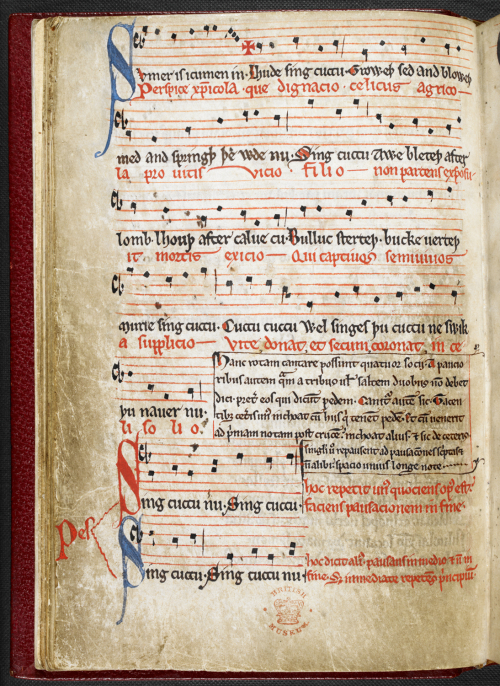
Skipping all the boring stuff, then, the Middle English text is in black. But there’s also a red lyric in Mediaeval Latin. Of course. Because in thirteenth-century England, as in twenty-first-century America, like it or not, Christianity was in everything.
So here’s “Sumer is icumen in” in West Saxon and New English followed by “Perspice Christicola” in Mediaeval Latin and New English—and red. The “þ” is called a “thorn” and was pronounced as a voiceless dental fricative—a hard “th” as in “think.” The “u” also functioned as a “v,”— a voiced fricative—as in “uerteþ,” which would have been pronounced something like “varteth,” meaning “farts.” (Because in the south of England in general stressed—and to a lesser extent unstressed—fricatives tended to be voiced and still are.) One wonders whether thirteenth-century farmers realized that flatulent animals contributed to global warming.
Anyway:
Sumer is icumen in
Lhude sing cuccu
Groweþ sed
and bloweþ med
and springþ þe wde nu
Sing cuccu
Awe bleteþ after lomb
lhouþ after calue cu
Bulluc sterteþ
bucke uerteþ
murie sing cuccu
Cuccu cuccu
Wel singes þu cuccu
ne swik þu nauer nu
Sing cuccu nu • Sing cuccu.
Sing cuccu • Sing cuccu nu
Summer has arrived,
Sing loud, cuckoo!
The seed is growing
And the meadow is blooming,
And the wood is blossoming (leafing) now,
Sing, cuckoo!
The ewe is bleating after her lamb,
The cow is lowing after her calf;
The bullock prances,
The buck farts,
Sing merrily, cuckoo!
Cuckoo, cuckoo,
You sing well, cuckoo,
Never stop now.
Sing, cuckoo, now; sing, cuckoo;
Sing, cuckoo; sing, cuckoo, now!
Perspice Christicola, que dignacio!
Celicus agricola, pro vitis vicio,
Filio non parcens,
exposuit mortis exicio.
Qui captivos semivivos a supplicio,
Vite donat et secum coronat
in cœli solio.
Look, Christian, such honor!
The heavenly farmer, because of a defect in the vine,
not sparing the Son,
exposed him to the destruction of death.
To the captives half-dead from torment,
He gives them life and crowns them with himself
on the throne of heaven.