Display the Hexalogue
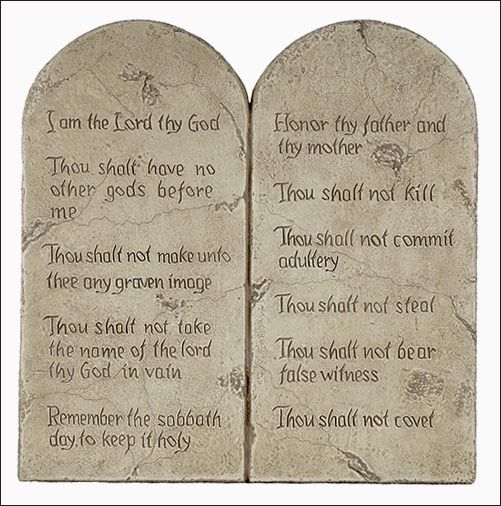
21 June—Forget about the religious or secular motivation of politicians and others who want to mandate the display of the Ten Commandments in various public places. Consider that six of the commandments are purely secular and pragmatic in nature; and fundamental to the ethical and legal traditions of the United States and most other presumably civilized nations, societies, and ethnicities—even those that don’t espouse or even accept the Abrahamic god that blesses America.
Not to put too fine a point on it, but where are kids not encouraged to honor—or at least not disrespect—their parents? Where is murder not a crime? Where—until fairly recently—is adultery not frowned upon? Where are theft and perjury not unlawful? As far as coveting—craving, lusting after—whatever or whomever, what’s that got to do with religion?
Remember—not too fine a point. So who but an amoral, selfish criminal could possibly have a problem with the last six commandments?
It’s the first four commandments that complicate the equation, on account of the First Amendment. But, realistically, what do gods have to do with the other six commandments? God leads off the Ten Commandments only because omnipotent, omniscient gods that were in every way superior to mere mortals were cleverly—brilliantly—created as an enforcement mechanism. Laws made by men are one thing, but you never want to rub a god the wrong way—especially The One God.
So what about a compromise? What about not fighting the public display of the last six commandments? It shouldn’t be mandatory, of course, any more than pledging the flag or any other symbols or acts of allegiance and obeisance. But there’s no reason to proscribe the public display of the purely secular Hexalogue rather than the partly religious Decalogue . . .