Spaniels v. Daniel’s
16 March—Study the picture carefully.
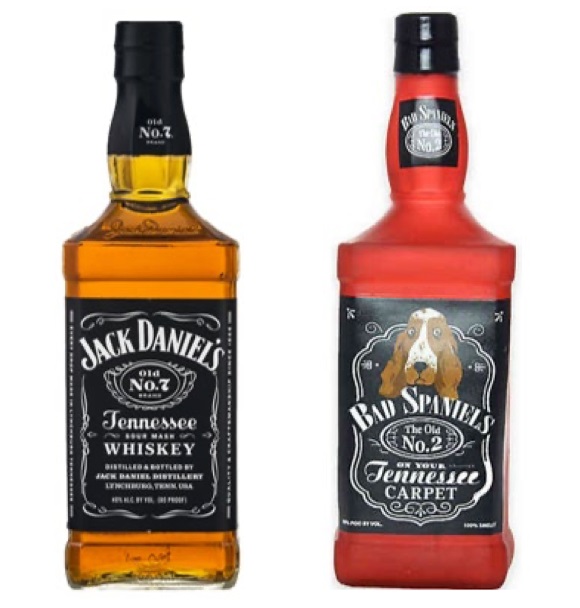
The image on the left is a bottle of Jack Daniel’s Old No. 7 Black Label Tennessee Sour Mash Whiskey. No doubt about it. The image on the right is not. No doubt about it; it’s Bad Spaniels The Old No. 2 On Your Tennessee Carpet. It’s a “Silly Squeaker” dog toy, for God’s sake! In all events, it’s obviously not a bottle of booze.
But Jack Daniel’s has a problem with Bad Spaniels and the United States Supreme Court will be hearing it in oral argument next week. The case is Jack Daniel’s Properties Inc. v. VIP Products LLC (Docket 22-148).
After being warned by the booze maker, a Delaware corporation (of course), of possible infringement of so-called trade dress related to the whiskey bottle, label, and name, VIP, an Arizona-based maker of dog toys, had sued Jack Daniel’s seeking a judgement that Bad Spaniels was within the fair use allowance because it was parody. VIP also wanted to cancel Jack Daniel’s trademark on its bottle design, though that may have been asking a bit too much.
Surprisingly—incredibly, even—the trial judge in the U.S. District Court for Arizona gave it all to Jack Daniel’s, finding that VIP’s use of the trademarked elements was not protected by the First Amendment and in fact diluted Jack Daniel’s trademarks (if not the booze. Sorry.) So VIP was enjoined from selling the toy for teetotaling pups.
How, you ask, could anyone not three sheets to the wind confuse a Bad Spaniels dog toy with a Jack Daniel’s bottle? Well, the booze maker’s clever lawyers confused the trial judge. That’s precisely what they’re paid for.
So VIP appealed that incredibly stupid decision to the Ninth Circuit and it unanimously vacated the humorless trial court’s ill-founded ruling on trademark infringement, finding that the dog toy was an expressive work entitled to First Amendment protection. It also reversed the trial court’s ridiculous judgement on trademark dilution because the Bad Spaniel toys were obviously used to convey a humorous message, thus affording further protection under the First Amendment.
But Jack Daniel’s wasn’t going to let Bad Spaniels lie. (Couldn’t resist.) Happily (hopefully, for creative survival), the Supremes, who are supposed to decide on issues of law rather than disputed questions of fact, were willing to take the case.
The whole Spaniels v. Daniel’s affair seems cut and dried to me in all respects. But I’m not a highly paid lawyer. And there are various aspects of the case—fair use and parody, for two—that could do with further clarification and fortification by the Supremes. But is this SCOTUS the one to do it?