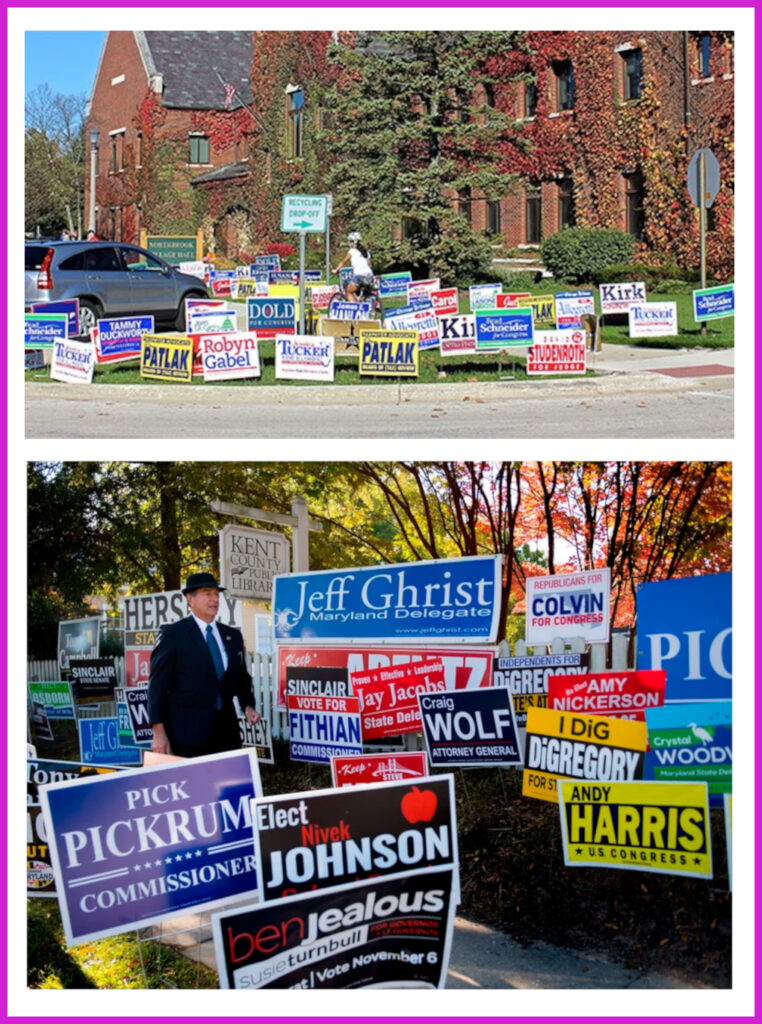
Signs of the time
20 October—Local Election Day is just two weeks away. Just? It’s a virtual lifetime for candidates who use the final fortnight effectively. In all events, lawn and yard signs have been planted on and uprooted from public and private property since at least two weeks ago and others have been left in place but defaced.
The value of campaign signs to anybody but the people who produce and sell them is questionable. Demonstrations and protests certainly allow people to express themselves positively or negatively. Knocking copy—negative advertising, whether truthful or defamatory, aimed at candidates and ballot issues—in all media, including signage, is known to be effective.
But virtually all candidate signs are explicitly or implicitly positive or provide nothing but candidates’ names, perhaps political affiliation, and sometimes portraits. So do they actually have any effect on election outcomes? Probably very little at best. There’s increased exposure of candidates’ names, of course, which may have value for newcomers and “stealth” candidates—those who have better things to do than campaign. And people get to know how their neighbors and others they respect or whose businesses they patronize feel about candidates and issues.
By and large, though, lawn and yard signs are a waste of time, effort, and money. Still, in Connecticut and most other places stealing and defacing political signs is a crime: in addition to trespass on private property, it’s criminal mischief, vandalism, and/or larceny in all cases. But it’s seldom treated seriously by police. Eyewitnesses to sign vandalism might just as well keep it to themselves. Everybody does it, after all. And most sign thieves and vandals don’t even bother lying about it.
In Connecticut, despite the U.S. Constitution’s First Amendment and the Connecticut Constitution’s Article 1, political and other non-state or otherwise authorized signage is not permitted on any state property, including but not limited to state rights-of-way. Crews from the Connecticut Department of Transportation are supposed to pull up signs from state rights-of-way for far-fetched “public safety” reasons and deposit them in back of ConnDOT garages. Suffice to say, sometimes they do, sometimes they don’t—pull up and/or deposit.
In the sanctimonious Borough of Litchfield, whose charter and bylaws supersede the federal and state constitutions, no signage or decoration of any sort (without the imprimatur of the blessed BOLBOWAB) is permitted on the green, which has in fact been consecrated by the blessed BOLBOWAB.
On the other hand, who needs: