Should history repeat?
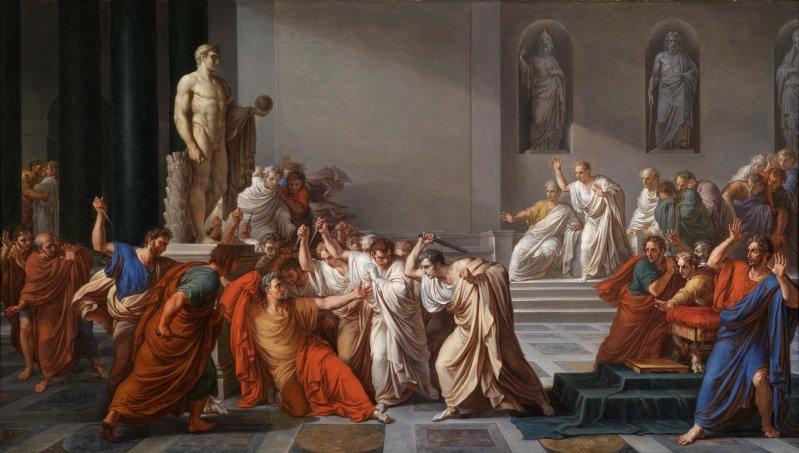
15 March—Today is observed here and there as the Ides of March. It’s best known these days as the date on which Julius Caesar was assassinated in 44 BC (or BCE, if you insist) in the Curia of Pompey during a session of the senate. Why, you may wonder, did a group of senators want to get rid of JC 44 years before the other JC was born?
Well, Julius Caesar wasn’t a draft dodger but was a brilliant and eminently successful military commander. He also was an insidiously manipulative and successful politician and thus managed to get himself declared dictator for life. Although there were no term limits, it was against everything the Roman Republic stood for.
While dictators came and went and were a fact of life, the prospect of a megalomaniacal dictator for life—a tyrannical emperor who effectively was above the law—didn’t sit well with a group of senators who feared for the republic. Sound familiar? Why would that be? Spoil-sports? Insurrectionists? Go figure? In all events, in order to preserve the republic Julius Caesar clearly had to go. And the rest is history and theater.
Trouble is, Julius Caesar’s assassination led to a period of instability (to put it mildly) and civil war and ultimately to the establishment of the Roman Empire—a monarchy ruled by a succession of tyrannical emperors, which superseded the Roman Republic—not for the better.
Suffice to observe that most of the senators who did the dirty were close to, trusted by, and at one time loyal to Julius Caesar. And he was a pretty easy target because he didn’t have the Secret Service to protect him.
As Marcus Brutus may have uttered, according to some sources, as he stabbed Julius Caesar, “Sic semper tyrannis.” “Thus always to tyrants.” It’s been Virginia’s motto since 1776 and John Wilkes Booth shouted it after shooting Abraham Lincoln.
Lincoln certainly wasn’t a tyrant. Things have changed. But an American Empire is unthinkable . . .