Paderewski
16 January—On this day in 1919, Ignacy Jan Paderewski (pronounced Ignotsy Yon Poderefski, rather than the way it’s normally mispronounced in Connecticut) became the first prime minister of the newly independent Republic of Poland. Technically it was the Second Polish Republic, established as part of the armistice with Germany that ended World War I. Hitler took it back in 1939, of course.
Poland in 1919 had been partitioned for over a century among Russia, Prussia, and Austria. Paderewski, 58 at the time, was a world-renowned concert pianist, composer, and philanthropist who had been a life-long advocate of Polish independence. But he turned out not to be much of an administrator or politician; so, unlike most of that ilk, he had the integrity to retire from politics, thus becoming a statesman. Returning to music, he didn’t set foot in Poland after 1924.
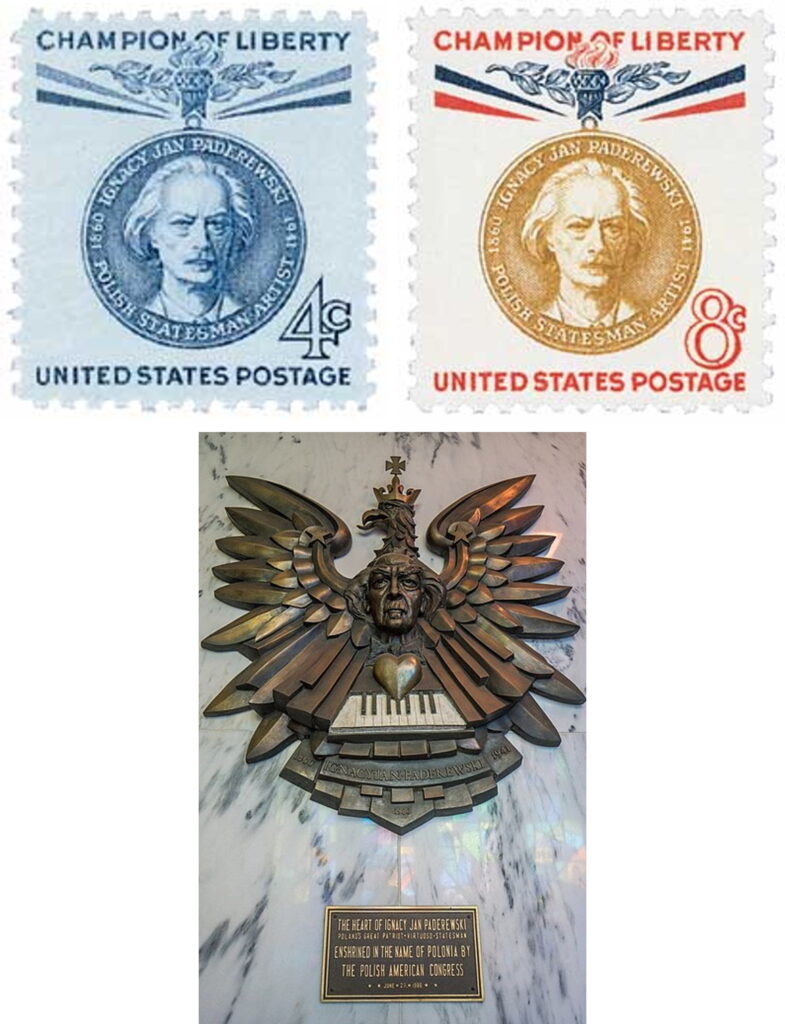
Paderewski died in New York in 1941, of pneumonia, and was buried in the Arlington National Cemetery. In 1992, after the end of Soviet-based communism in Poland, his remains were moved St. John’s Archcathedral in Warsaw. Except for his heart, which is in the National Shrine of Our Lady of Czestochowa near Doylestown, Pennsylvania, encased in a bronze monument to him. His portrait is on four-cent and eight-cent United States Postage “Champion of Liberty” stamps from 1960.
These days, Paderewski is best known for his delightful little “Minuet in G.” Here’s the composer himself playing it in the 1937 movie “Moonlight Sonata,” in which he plays himself.