Irregardless of Webster
16 October—Noah Webster was born 267 years ago today in the Western Division of Hartford, known today as . . . guess what. After Yale, he briefly studied law in Litchfield, but not at Tapping Reeve’s Law School (probably because he couldn’t afford it), and—after continuing his law studies in Hartford—eventually passed the bar exam. Did you know they actually gave bar exams back then? But law wasn’t his thing. So he went big-time into teaching, writing, editing, and publishing.
Noah Webster is best known (most well-known, as semi-literates would have it) as a lexicographer and compiler-author of the momentous and monumental “An American Dictionary of the English Language.” It followed Samuel Johnson’s momentous and monumental “A Dictionary of the English Language” by 73 years and isn’t as much fun to read.
While Johnson’s and Webster’s dictionaries were descriptive in presenting examples of historical usage, both were prescriptive in instructing people on proper spelling, pronunciation, and usage. Johnson sought to preserve the purity of English wherever she was spoke and to fix the language by ridding it of irregularities. Similarly, Webster sought to establish standards for the language on this side of the Atlantic.
These days, for better or worse, most dictionaries (of all languages) tend to be purely descriptive, showing examples of how words and phrases have been used while not attempting to tell readers how words should be used; they thus record the evolution of language. The “Oxford English Dictionary,” for instance, was originally called “A New English Dictionary on Historical Principles.”
So a nice volunteer who’s begging Connecticut Public Broadcasting listeners for money says “irregardless” in some context. At the very least, it grates on a grammarian’s sensibilities. We don’t want to think how Johnson and Webster would react to “irregardless” if they were alive. But you’d of thunk that someone at Connecticut Public would of caught it. Irregardless of them, Rosenberg ain’t happy with it. (And ain’t is a disquisition unto itself.)
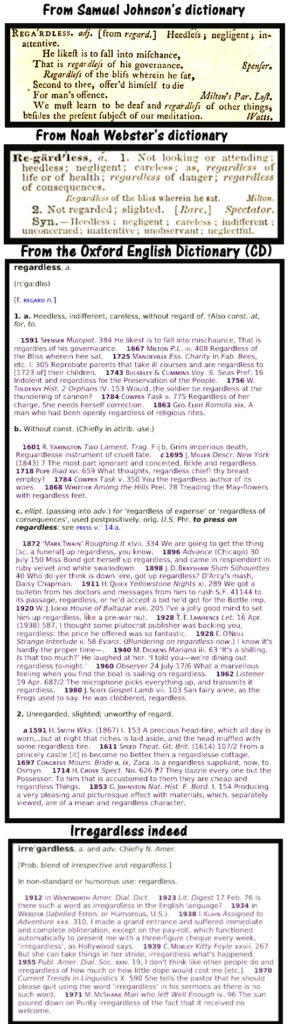
For the fun of it, then, here are Johnson, Webster, and OED on “regardless” and OED on “regardless” and “irregardless.” “Irregardless” hadn’t even occurred to Johnson and Webster—or anybody else before 1912, according to OED. And even the descriptive dictionaries that dutifully record that abominable word call it nonstandard (American spelling) or non-standard (British spelling).