Fuzzy Wuzzy was a moth
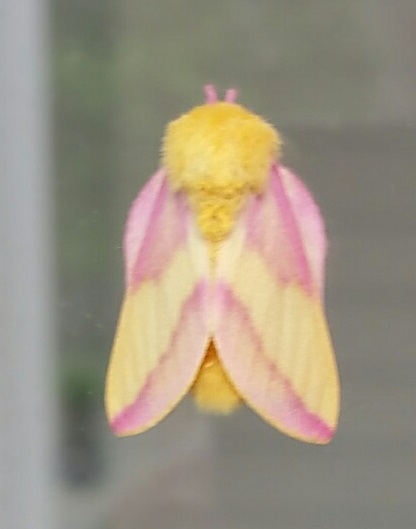
18 September—This is a picture I took recently of a rosy maple moth (Dryocampa rubicunda) that was relaxing on a door of the Litchfield post office. Although I can’t recall ever having seen one of these cute, fuzzy little creatures before, they’re not all that uncommon around here.
They’re the smallest of the Saturniidae, the great silk moths, having a wingspan of about 1½ inches. The adult females lay their eggs on the underside of maple leaves—particularly red, silver, and sugar maples, though they’ll also resort to various oaks in a pinch—and the emerging caterpillars—greenstriped mapleworms—feast on the leaves, eating whole blades. Happily, the defoliation doesn’t do permanent damage. Wouldn’t it be a bitch if these cute moths were as destructive as their less attractive cousins?
After gorging themselves, the larvae crawl down and pupate in the soil beneath the same tree whose leaves they’ve devoured. Why travel when everything you need is right at hand?
To atone for their gluttonous infancy, adult rosy maple moths, like all the Saturniidae, don’t eat. By thus staying in shape, the cute little bugs can live from two to nine months. And although the adults aren’t dangerous, the greenstriped mapleworm caterpillar is one of the so-called stinging caterpillars, having urticating—stinging—spines that contain a toxin and can irritate human skin if they come in contact. But the caterpillars aren’t cute anyway, so you wouldn’t want to pet them . . .