Crosses to bear
18 December—Only a week to Xmas. Wow! Can’t wait for Santa’s reindeer to poop on the roof while the “Eurocentric white male epitomizing a heteronormative religious paradigm that reinforces patriarchal structures while marginalizing non-Christian and BIPOC narratives” breaks into the house. (Thanks to Mallard Fillmore; and BIPOC is an acronym for black, indigenous, and people of color, by the way.)
And, no, Xmas isn’t in fact a secularization of Christmas—it’s not taking Christ out of Christmas at all. God forbid! That’s because X is really a traditional abbreviation of Christ. It’s a Romanization of the Greek letter Chi, the first letter of the Greek word Χριστός (Khristos), meaning anointed, which became Christ in English. So there.
X is also the shape of the crux decussata, the decussate cross, better known as the Saltire or St. Andrew’s cross. Decussate, the adjective and verb, come from the Latin decussare, meaning to divide crosswise. It’s used primarily in anatomy.
Saltire is an heraldic term from the Old French salteur, derived from Latin saltatorium, a type of stile (barrier) to inhibit the passage of cattle. It’s only tangential to decussare, so we’ll leave it there. But the crux decussata is known as St. Andrew’s cross because back in 60 A.D. the Apostle Andrew was crucified on an X-shaped cross—at his own request, since he had to be martyred—because it’s said that he believed himself unworthy to be crucified on a cross like the one on which Christ had met his (theologically mortal) end. One wonders why the Roman buggers accommodated the poor sod.
Christ was most likely crucified on what’s now known as a Roman or Latin cross, crux immissa or crux capitata—inserted cross or cross with a head. Turned upside down, it becomes St. Peter’s cross (guess why); and sideways it’s St. Philip’s cross (same reason). There’s an absolute surfeit of crosses, so we’ll have to stop with the crux commissa (attached cross), a.k.a. Saint Anthony’s cross, Saint Francis’ cross, and the Tau cross—because it’s shaped like a T.
(But Jehovah’s Witnesses maintain that Jesus died on a single wooden stake, called a crux simplex, or simple cross, even though it’s not a cross at all.)
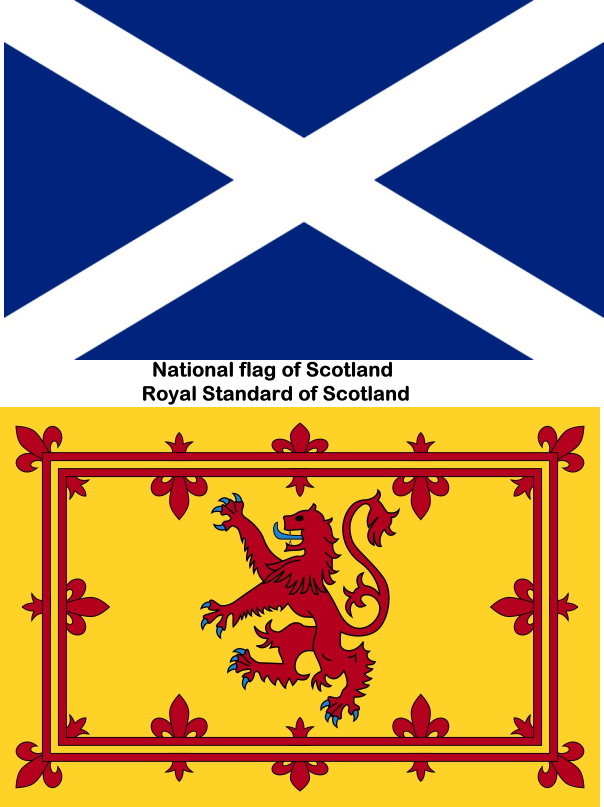
Anyway, Andrew became the official patron saint of Scotland by the Declaration of Arbroath in 1320. And Scotland’s national flag consists of a white saltire on a blue field. And never but never confuse that with the Royal Standard of Scotland, with a red lion on a yellow field, lest the ridiculous royals sue you . . .