Coping with copying
23 November—Yesterday was what pleonasts call the 58 year anniversary of the assassination of President John F. Kennedy in Dallas. Do you remember what you were doing when you learned that JFK had been shot?
I was in my college’s English faculty office making some Verifax copies of my illustrated notes on John Webster’s delightful revenge tragedy “The Duchess of Malfi” for a seminar on Jacobean drama. Who the hell was John Webster? Don’t worry. But he was the kid in the street in “Shakespeare in Love” who told Shakespeare that when he wrote plays they’d be like “Titus Andronicus,” full of blood and gore.
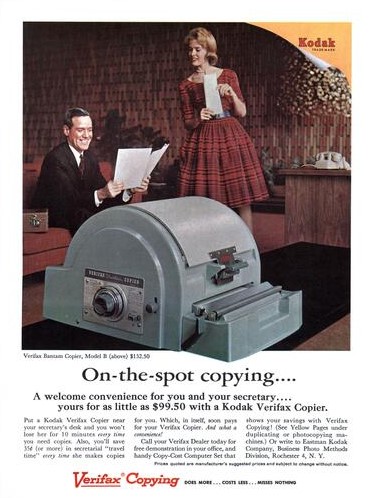
More to the point, for all my younger readers, what the hell are Verifax copies? Well, back in 1963, the college president’s office had a Xerox, but the department offices, as I recall, had to make do with Verifaxes or Ditto machines.
Kodak Verifax involved a machine with an arched platen, several steps, liquid, peeling, squeegeeing, drying, and quite a bit of patience. It was no fun, to be sure. And Verifax copies tended to fade over time. But Verifax was considerably less messy than the mimeograph and could reproduce pictures, however poorly.
In addition to lots of carbon paper, the English office also had a Ditto machine, of course, since most of its mass duplication and reproduction involved words rather than photographic images. With Ditto—spirit duplication—you typed or scribbled a stencil, which you placed on a drum and spun around as paper was fed through. The Ditto spirit smelled like rubbing alcohol because that’s essentially what it was. Spirit duplication, like Verifax, was considerably less messy than mimeograph.
The last time I saw a mimeograph machine must have been in the early fifties, when I was the PS 174 mimeograph monitor, among other things. Like the Ditto, the mimeograph used stencils on a revolving drum. Unlike the Ditto, the mimeograph used messy black ink. But in those days I was a neatnik and never had a problem with recalcitrant ink, never got it on me or anywhere else it wasn’t supposed to be. And there was always cleaning fluid and Gre-Solvent for ink attacks.
On the other hand, there was my assistant, Michael. This kid’s father was a lawyer with a new Lincoln every year; his mother was a teacher with his father’s Lincoln the following year; and they lived in a fancy modern (better than Bauhaus) house a couple of blocks away. Lovely people, actually. And Michael wore Saks Fifth Avenue shirts and ties and pants. Probably Saks Fifth Avenue underwear too, but I wasn’t that curious.
Michael was a very bright kid. And a friend in spite of it. But a slob to the core, the acme and epitome of irredeemable sloppiness. I expect he didn’t want to be a slob, but he just couldn’t help himself. Unfortunately, he was the only kid who volunteered to be my mimeograph assistant. I’d have given him more credit, but what did I know?
My father had given me an old lab coat of his so I wouldn’t mess up my bargain-basement clothing. But I didn’t need the lab coat, of course, so I let Michael use it. And even with the buttoned-up lab coat and sometimes even a smock over that, Michael managed to go through a shirt, tie, and pants every day he even approached the mimeograph. That was about once a week.
After a couple of months on the job, his mommy asked me to fire Michael. I must have been 11 and had never done anything like that before. Or since. He accepted his fate with great aplomb and we remained friends—and he remained a slob—through junior high school, anyway. He went on to a prep—I think it was Andover—and probably became a corporate lawyer and has remained a slob . . .