Chickens tortured just to fill your gut
13 February—Yesterday’s poll, whose results appear in today’s Republican-American: “Do you think all chickens on animal farms should be free range?” Results: “Yes, it’s more humane . . . 56%; No, they’re just chickens . . . 38%; Not sure . . . 6%.”
Good poll, but like all surveys and polls, it’s all in the wording and the wording of this one is imperfect. The USDA, for instance, defines “free range” far too broadly to really mean anything. But the moronic assholes who chose “No, they’re just chickens” should be forced to live in inhumane conditions like any captive animals are forced to endure on factory farms.
Especially chickens, which, like turkeys, are subjected to some of the most inhumane treatment of any factory-farmed animals. Extreme confinement, surgical procedures performed without painkillers, and the denial of normal socialization opportunities are among the many abuses that make factory-farm chickens’ lives always difficult and usually unbearable.
Even on small farms, for every egg-laying hen, about one male chick is cruelly killed as a newborn by suffocation, gassing, maceration, or electrocution, simply because he is considered a useless by-product who can’t lay eggs or grow large enough for meat. In the United States, more than 260 million male chicks are killed in the egg industry every year—that’s around 30,000 newborn chicks killed every hour, sacrificed for no good reason.
Newborn chicks typically have 1/3 to 2/3 of their extremely sensitive beaks seared off without pain reliever. Debeaking is standard practice in the egg industry, including on most cage-free and free-range egg farms. A chicken’s beak is the sensory equivalent of a human fingertip—loaded with blood vessels, pain receptors, and free nerve endings that facilitate food detection in the wild.
While their normal lifespan is eight to 10 years, hens used for eggs are generally killed at 12 to 18 months, when their egg production declines. Then they’re either slaughtered for their meat—being paralyzed by electric shock and having their throats slit—or they’re disposed of by being gassed or thrown alive onto dead piles.
In natural and normal conditions, a laying hen, due to the energy required, can produce just an egg a day, but wild hens usually lay only 12 to 18 eggs a year. Hens on factory farms, on the other hand, are induced by artificial means to lay 300 eggs a year. No respite in their inhumanely tiny cages with constant artificial lighting.
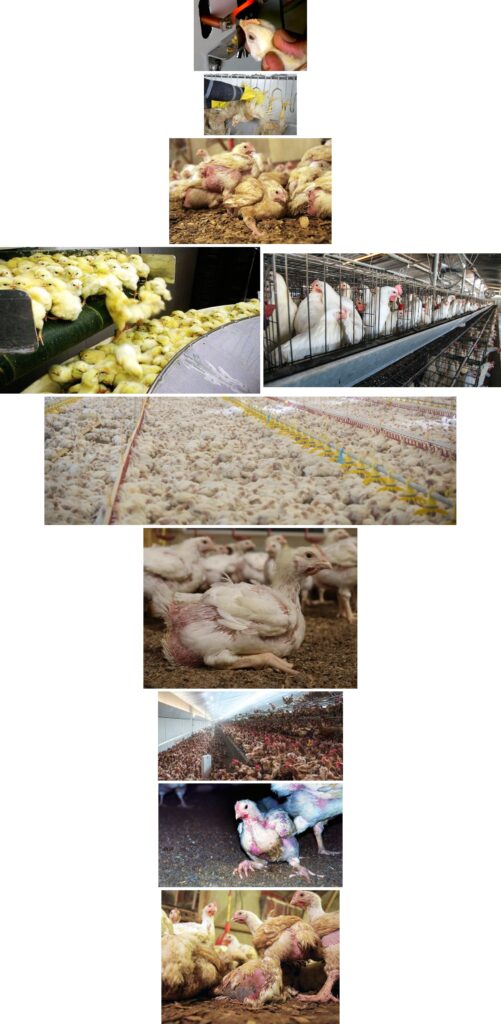
Here are some pictures of chickens existing and being tortured for egg and meat production on factory farms. There are some 300 million egg-laying hens enduring inhumane conditions on factory farms in the United States. And there are 9.2 billion of these unfortunate creatures slaughtered in this country alone every year, of the 68 billion in the world . . .