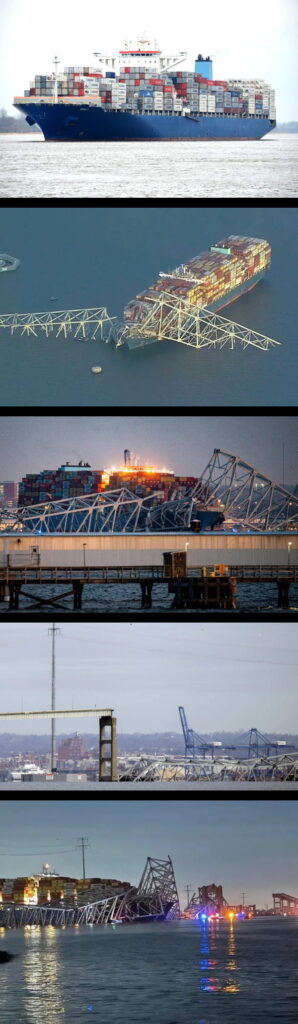
Bridge under troubled waters
26 March—The Patapsco River was first explored by Captain John Smith (of Jamestown, Virginia fame) around 1610. He called it the Bolus River; Patapsco is Algonquian for backwater. The Patapsco flows into Chesapeake Bay and its mouth forms Baltimore Harbor. That’s where Francis Scott Key, aboard the British ship of the line, 80-gun (captured from the French) HMS Tonnant to negotiate the release of a POW, wrote The Star-Spangled Banner, the poem that was added to a drinking song to become the American national anthem.
That’s why, among the many bridges spanning the Patapsco’s 39-miles (and two tunnels under it) there’s one called the Francis Scott Key Bridge. At least, there was. Now a lot of the Francis Scott Key Bridge is in the Patapsco River.
The Port of Baltimore is an ultra-major, ultra-busy Atlantic shipping facility, handling, inter alia, most Mercedes-Benz imports and a quarter of American coal exports. But at 1:28 this morning maritime access to the port was effectively blocked when the MV Dali, a 95,000-ton, almost 1,000-foot-long Singapore-flagged container ship bound for Colombo, Ceylon (or the Democratic Socialist Republic of Sri Lanka or whatever it’s called now), with an ETA of 22 April, took out the Francis Scott Key Bridge.
There goes the American economy.
So two questions come immediately to mind: First, was the MV Dali named after the great surrealist artist Salvador Dali? Second, since the Dali hit the bridge with such surreal perfection, was the captain (or coxswain, helmsman, steersman, or whoever does such things on big boats) actually aiming for it?