Trump and Torquemada
16 September—It appears that somebody had a rifle too close for comfort to Donald Trump when he was playing golf in Florida but the only shots fired came from the Secret Service bodyguards. What, you may ask, was Trump doing playing golf when he should have been out campaigning?
It’s possible, but not at all likely, that Trump learned from Joe Biden’s rather surprising success in 2020 that the less he’s seen and heard the better for his campaign.
On the other hand, consider that when Trump’s ear got shaved by an alleged would-be assassin’s bullet last month, it got him a groundswell of sympathy, support, and—most important—campaign money. And shortly after the announcement of yesterday’s golf course incident Trump’s posting included a fund-raising solicitation.
So it wouldn’t be at all surprising if Ryan Routh, the guy who had allegedly pointed the Soviet AK-style semi-automatic rifle at Trump, actually had been hired by Trump’s campaign lackeys to wheedle sympathetic support out of the uncommitted unwashed—as well, of course, as scratch from the committed unwashed and washed. Just saying.
ﷺ ﷺ ﷺ ﷺ ﷺ ﷺ ﷺ
Speaking of bad people, today we celebrate the death in 1498, at the age of 78, of Tomás de Torquemada, the first and most brutal Grand Inquisitor of the Tribunal of the Holy Office of the Inquisition (Tribunal del Santo Oficio de la Inquisición), commonly known simply as the Spanish Inquisition. Donald Trump is 78 now. Just saying.
To refresh your memory, the Spanish Inquisition was created in 1478 by the Roman Catholic King of Aragon and Queen of Castile (Ferdinand and Isabella of Columbus fame), who had married and given birth to the Kingdom of Spain. The Inquisition’s rather vague stated purpose was to uphold “Catholic religious orthodoxy” by identifying heretics among converts to Catholicism from Judaism and Islam. No Protestants to pick on back then.
Contrary to common belief, since in the bad old days there was no separation of church and state (and don’t for one minute think the U.S. Constitution has made too much of a dent in that), the Inquisition functioned primarily as a private police force and prosecutorial service for Ferdinand and Isabella and succeeding monarchs.
Technically speaking, the Inquisition had no authority over non-Catholics; and they had been forced into exile if they didn’t convert anyway. So the Spanish Inquisition was essentially like the U.S. Department of Justice as envisioned by Project 2025.
To put it very mildly, the inquisitors, like Torquemada, relished their job and weren’t at all nice about how they went about their interrogation, torture, and murder. Surprisingly, the Inquisition wasn’t abolished until 1834, although the modus operandi had (only) somewhat moderated by then. But it wasn’t until 2000 that Pope John Paul II apologized for Roman Catholics’ sinful behavior in the name of their faith, including but not limited to the Spanish Inquisition.
Tommy Torquemada was known to be a pious Dominican friar and his auto-da-fé strategy was generally supported by public opinion, at least in the early days of his 15-year tenure as Grand Inquisitor.
Auto-da-fe, by the way translates as act of faith. It has the acute accent in Portuguese, not in Spanish. It was a practice in the Inquisition era of public punishment, usually ritual execution. The public has always liked a good show . . .
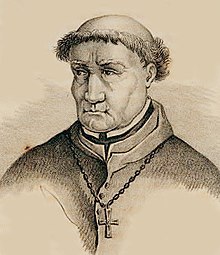
Torquemada left his own epitaph: Pestem Fugat Haereticam
(Drove away the pestilence of heresy)