The green old deal
17 March—In observance of St. Patrick’s Day, bad news first: Connecticut Democrat Junior U.S. Senator Christopher Murphy. He’s been pretty bad news from the get-go, of course, but his latest publicity stunt popped up last week when he proclaimed the need for a 32-hour work week—with 40 hours worth of pay.
Pandering to his base, as usual, Murphy maintained that a 32-hour work week will allow workers to fulfill their lives outside of work. “A lot of people find value in work,” Murphy reluctantly admitted, “and I’m glad that they do, but a lot of people find more value by the institutions and the social clubs and the churches that they affiliate and spend time with outside of work.”
Aw gee, it’s mighty white—make that magnanimous—of Senator Small Ball to recognize that some people don’t want to depend on the welfare state. (Need it be said that the welfare state depends and thrives on those who thrive and depend on it? Political symbiosis.) And Murphy probably cares about the indolent masses almost as much as he cares about illegal immigrants (whoops, “undocumented Americans”)—the “people we care about most,” as he boasted last month. But does he really believe that the indolent masses who don’t find value in work are going to find value in anything other than social clubs?
Robert F. Kennedy Jr. is more bad news on St. Patrick’s Day. The question is, for whom? So much for the Irish portion of The Monitor’s St. Patrick observance.
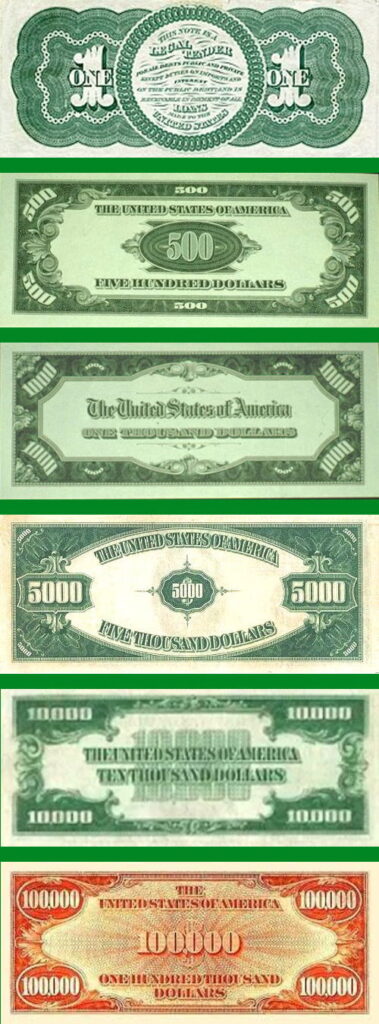
Here, then, is some green nostalgia, specifically greenbacks. The original greenbacks were emergency paper currency issued by the United States during the Civil War, so called because they were printed in green on the back. To this day, all American paper money, while not all green on the front, is in fact all green on the back.
Except for the $100,000 bill and the other few Gold Certificates, as opposed to the more common Silver Certificates and Federal Reserve Notes. About 42,000 $100,000 bills were printed between 1934 and 1935—only for gold transactions between Federal Reserve Banks. But that’s a whole nother story.
For now, the top picture is of the back of the original greenback, the four in the middle are of denominations no longer in circulation, the bottom is of the back of a $100,000 note; Woodrow Wilson is on the front. All are still legal tender, but private possession of the $100,000 note is verboten—except for educational purposes, of course.
The smaller large-denomination bills—$500, $1,000, $5,000, $10,000—were last printed in 1945 and officially discontinued in 1969. With never-ending inflation, shouldn’t we expect to see the $500 (at least) back in circulation before long?
Incidentally, greenbacks are what’s known as fiat money, backed by nothing more than what amounts to the full faith and credit of the United States Government. For all that’s worth. The Bureau of Engraving and Printing churns out currency whenever the Capitol whores want it for their nefarious self-preservation. And that’s one of the factors that contribute to inflation. Live with it . . .