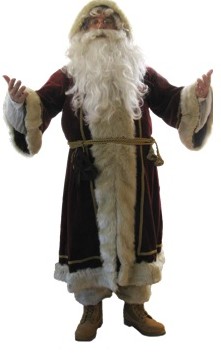
Annual Xmas history disquisition
לעבעדיק ניטל צו אַלעאון צו אַלע אַ גוטן טאָג
25 December—Today’s subhead is Yiddish for “Merry Christmas to all and to all a good day.” (Transliterated to English it’s “Lebedik nitl tsu ale aun tsu ale a gutn tog.” Of course, you have to read the Hebrew characters (Yiddish is written with the Hebrew alphabet) from right to left; otherwise, from left to right, it would sound more like “Got nawtig a ala ootz nu ala ootz l’teen keedevel.” And that makes no sense at all. Except, perhaps, to spies.
Why Santa’s Christmas greeting in Yiddish? Well, it’s not generally known—nor publicized for obvious reasons—that Santa was actually a Chabad Lubavitch escapee. Here’s the story. Hark back to the early nineteenth century, the town of Lyubavichi, which is now in Russia. A few decades after the ultra-orthodox Jewish sect had been founded.
Shmuel (Samuel, to us) Claustein was born into a recently converted Lubavitcher family. (Chasidic sects are generally named after the towns where they originated.) And he was a pious Lubavitcher. Frum is the Yiddish word for that.
For instance, Shmuel never shaved or trimmed his sidelocks (known as payis or, more fashionably, payot) because Leviticus 19:27 told him (in Hebrew, mind you), “Thou shalt not round off the side-growth on thine head, or destroy the side-growth of thy beard.” But Shmuel was a good person anyway. He was totally honest, straight as an arrow, incorruptible and uncorruptible, not a goniff, nor sanctimonious like the other Chabad Lubavitchers. And that’s precisely why he was excommunicated, ostracized, and exiled. There simply was no room for a good person in the Chabad community. Even back then.
And even back then, Jews weren’t particularly welcome anywhere. To put it mildly. So where could Shmuel go? By then he was calling himself Sammy. It happened that the first stagecoach out of Lyubavichi was an express to Lapland. So with the money he was able to squeeze out of his reluctant parents (who had 14 other children to support), Shmuel booked a business-class seat on the stagecoach to Lapland.
When he finally got to Lapland, Sammy found that the people living there were called Sámi, so he felt right at home from the get-go. Better yet, the Sámi had nothing against Jews. Because they didn’t even know that Jews existed.
The Sámi tended to be short of stature, were handy, didn’t belong to labor unions, and raised reindeer. What more could a young entrepreneur ask for? Even an honest one. So, with minor modifications to his name for PR purposes and a little fiddling with inconsequential facts Sammy founded the business that still thrives after two centuries.
And the white beard? Well, Santa Claus (as Sammy Claustein now was known) still faithfully followed Leviticus 19:27 and only strategically trimmed his whiskers and never shaved. (There’s something to be said for not shaving.) In his youth, Shmuel’s hair had been red. But by the time cameras were being used for commercial photography, Santa Claus was an old fart with white hair.
Being a frum (albeit honest) Chasid at heart, Santa Claus still dressed in a modified Chasidic manner, with fur-trimmed schmatas, as you can see below. His uniform (not a costume, mind you) became red only after SC’s death at 102, which was about the time Thomas Nast was drawing his political cartoons. And, as attentive readers know, it’s Nast who gave Santa his red suit. By that time, of course, Santa was living in Litchfield, where, like the Sámi, the residents didn’t know he was you know what . . .