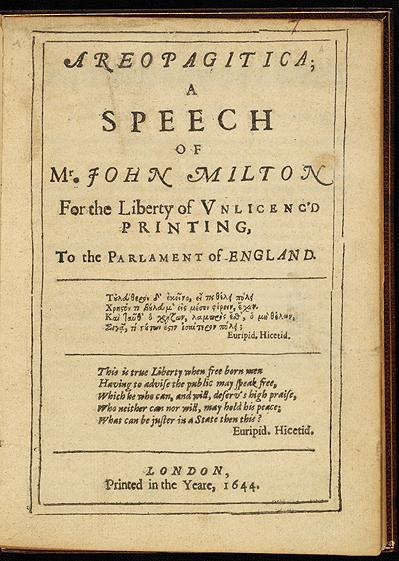
Areopagitica!
23 November—It’s 379 years ago today that “Areopagitica” hit the stands. Wow! you’re thinking. Wow indeed. Because it’s one of the few of John Milton’s many tedious works that’s worth even trying to plow through. Milton, to put it mildly, is not easy to read. He was a rather brilliant, erudite, and prolific seventeenth-century English writer, considered by professors and critics who want to impress each other to be the most significant English author after Shakespeare. (Shakespeare who?)
John Milton is best known for “Paradise Lost,” his excruciating biblical epic poem in blank verse about the temptation of Adam and Eve by the fallen angel Satan and their expulsion from the Garden of Eden. About a decade ago it almost became a movie. In all events, for some reason “Paradise Lost” is considered Milton’s masterpiece.
Not one to leave well enough alone and being a good Christian, Milton also did a torturous sequel, “Paradise Regained,” about Jesus and the good guys. That was published with “Samson Agonistes,” a closet tragedy (in blank verse, of course)—intended for reading rather than performance—that gave us the beautiful phrase “eyeless in Gaza,” used by Aldous Huxley as the title of a novel and The Monitor as the title of a disquisition. Incidentally, John Milton was himself blind when he wrote “Samson Agonistes.”
Back on topic, then, in 1644 Milton was offended by government licensing of printing and publishing and censorship in general. Good authors always are and must be. So he wrote “Areopagitica” in the form of a classical oration (of course), following one (of the same title) by ancient Greek rhetorician and speech writer Isocrates, also intended for publication rather than real-time delivery, directed to the Areopagus, a sort of Athenian senate at the time.
Milton maintained, quite passionately and rightly, that only tyrannical governments demanded the expression of uniform beliefs compatible with their own interests. To prove his point, he presented examples of censorship throughout history, all of which originated with repressive governments. Milton’s thesis was that the publication of truth must never be hindered. Freedom of speech, period. Right on, John!
In “Areopagitica” and elsewhere, Milton made the case that it was the right—and duty—of intelligent, rational people to know and understand what they were about and to take responsibility for their beliefs and actions. And that could be accomplished only through open discussion—call it debate—in which sources of information (news, for instance) weren’t restricted or contaminated by governmental authority in the interest of partisan advantage. Political unity, he opined, was achieved by consensus that respects variety of opinion, rather than by force.
John Milton—and Isocrates before him—were addressing the evils and fallout of government censorship, of course, but that’s only because news, entertainment, and social media were nothing to speak of in the fourth century BC and seventeenth century AD. Today, unfortunately, not only do all the media have too great an influence on an intellectually lazy populace, but politicians and others of all persuasions want to restrict and even ban anything that rubs them the wrong way. If the media won’t do it voluntarily, government will make them do it, First Amendment be damned.
That must never but never be allowed to happen . . .