Pi in the eye
14 March—Today is Pi day, named for the 16th letter of the Greek alphabet, Π (capital) π (lower case), which represents the plosive P sound and has the value of 80 in Greek numerals. More to the point, in Euclidian geometry it’s a constant, the ratio of a circle’s circumference to its diameter. That’s where the 3.14 comes in. March=3, 14th=14. I learned π as 3.1416 in the antediluvian time of analogue slide rules.
Carried to 100 places, Pi is 3.1415926535 8979323846 2643383279 5028841971 6939937510 5820974944 5923078164 0628620899 8628034825 3421170679. Imagine doing that on your little slide rule. Π also represents other things, but we don’t care about those on 14 March.
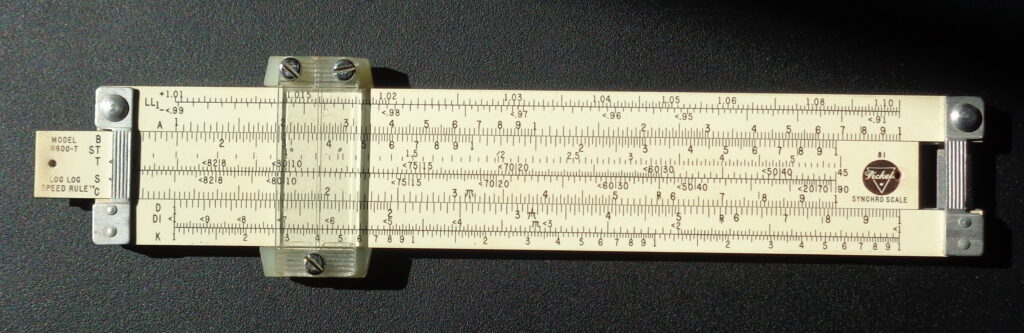
Back to Pi and slide rules. The engineers called them slip sticks. Surviving engineers probably still do. But—thankfully—I’ve never been nor aspired to be an engineer. The popular slide rules of the day, as I recall, were made by Keuffel and Esser and Pickett & Eckel. My brother gave me the P&E slide rule pictured below when he went off to med school. It’s been relaxing for six decades. Not that it ever got too much of a workout when I actually had to use it. Ever.
And then there were those marvelous logarithmic tables. They were a great convenience, to say the least. And logarithms, invented by a very patient, obviously brilliant Scottish laird called John Napier at the beginning of the seventeenth century, led the way to slide rules, invented first by Edmund Gunter of Oxford in 1620 and improved by William Oughtred of Cambridge in 1622, who essentially combined two Gunter rules.
Nothing like good old-fashioned analogue reminiscence to get your heart pumping. While it still can. But even though digital can be a frustrating pain in the ass, it’s nice to have it.
(In the military way I write dates, by the way—14 March or 14.3—143 is code for “I love you,” dating back to the 1990s when it was especially used on pagers. Remember pagers? The military? The 1990s?)