22 August—The 7 June 2025 disquisition about the unjust conviction of Bob Fisher for defending himself against a crazed drunk is reposted here, with the penultimate paragraph in bold italics for your convenience.
That’s because yesterday the Connecticut Appellate Court overturned the ludicrous, unwarranted conviction on the ground the judge hadn’t in fact told the jurors—or anybody else—about his new job, thus creating “an appearance of a lack of impartiality.”
The unjust conviction could and should have been thrown out on any number of other grounds, but Prescott’s silence about his new job is better than nothing. Unfortunately, however, the case has been remanded to the Superior Court and the appellate decision may be appealed to the state Supreme Court. In all events, the tenacious prosecutor insists, “Regardless of the outcome of any further appeals, the Litchfield State’s Attorney’s Office stands ready and willing to retry the case at any time.” Screw him.
Bob Fisher is a victim, not a criminal.
7 June—Seventy-eight-year-old Atty. Bob Fisher, who should not have been convicted of manslaughter or anything else for defending himself against a younger, physically fit, alcohol-crazed attacker who had punched him several times, was sentenced yesterday to two-and-a-half years in prison, a possible death sentence for a man his age not in optimal health.
The six-person Torrington jury that convicted Fisher three months ago doubtless took great delight in making a lawyer—any lawyer—squirm before not doing the right thing by acquitting him when all the evidence showed beyond any doubt that he had no choice but to shoot his attacker in self-defense. As I wrote the day after the unjust conviction, the jury “deliberated or partied for only three hours” before delivering its ill-considered, disgracefully unjust verdict.
Since the jury didn’t do the right thing, however, the trial judge could have overruled the clearly biased verdict. But Eliot Prescott, an appellate judge presiding over a trial-court case, chose not to do the right thing. Evidently Prescott had been sent to down to the Superior Court for what’s called caseload management—too many cases, not enough judges to try them.
Could it be, then, that Prescott, wanting to move things along, didn’t appreciate that Fisher, knowing his innocence and having faith in American justice (even in Connecticut), had refused to accept a plea deal and insisted on his right to a trial, thereby taking up a courtroom and Prescott’s time?
Judge Prescott certainly could have redeemed himself (at least somewhat) by showing some mercy and respect for justice by not sentencing Fisher, a man with no criminal history and a sterling pre-sentencing investigation, to any time behind bars. But Prescott’s resentment clearly got the better of him and he wouldn’t even grant Fisher appellate bond.
Connecticut’s Criminal Justice Commission in April appointed Eliot Prescott to be the state’s next (second) inspector general, whose job it is to investigate when people die in police custody and decide if police officers should be criminally charged for killing people in the line of duty. Unfortunately, Prescott doesn’t start that job until next month. And pity innocent police.
It’s worth noting, by the way, that the Connecticut Criminal Justice Commission is the very body that hires prosecutors. Did Prescott tell the jurors that?
In all events, Prescott told the commission at his interview, “I’ve made unpopular decisions on the bench.” We know . . .
21 August—This unposed (i.e., candid) picture was taken and distributed by one of Donald Trump’s now-former faithful flunkies who could neither believe nor stomach the miasmic stench emanating from the bottle-blonde bozo. While the Monitor doesn’t as a rule defend Donald Trump, in this instance we must point out that his body odor is entirely understandable and appropriate. Because Donald Trump is so full of shit . . .

20 August—Dr. Judge Michael Peloquin must have something—anything—better to do than antagonize virtually everybody in Litchfield and threaten and otherwise harass any and all who dare to apprise the public of things—facts in the public domain—he would prefer to not have known. So why doesn’t he do it? But where’s the fun in that?
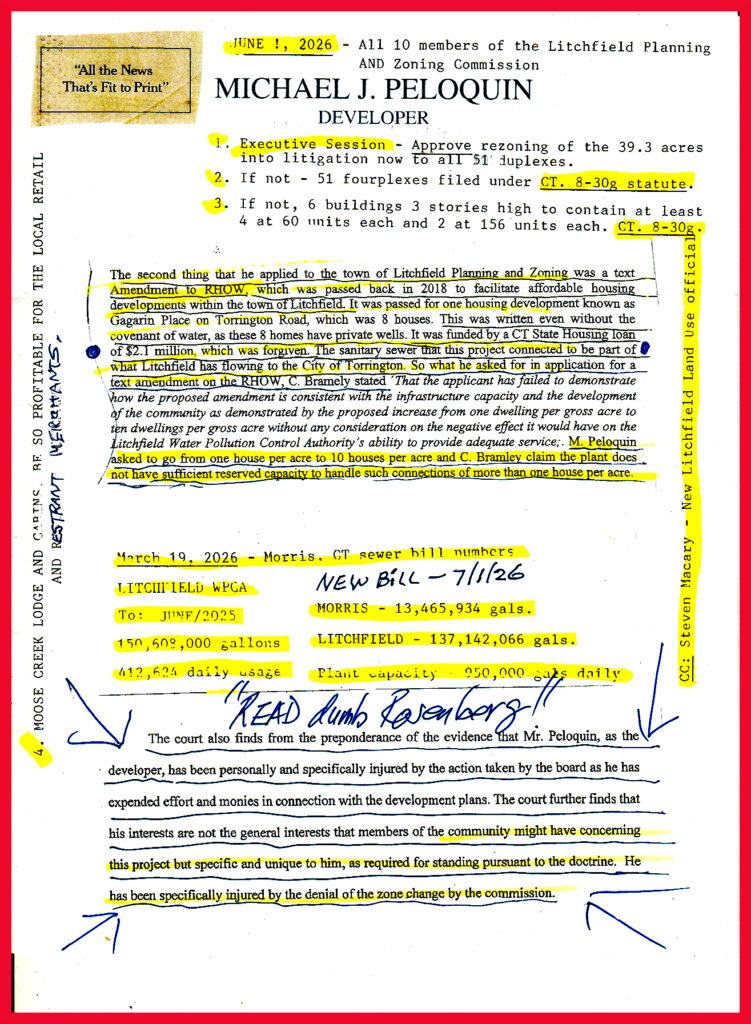
Dr. Judge Peloquin’s latest communication, received in an envelope addressed to “PAUL ROSENBERG, Litchfield Monitor,” at the wrong PO box (as usual), consists of a brief definition of libel and an abbreviated delineation of types of libel damages as well as the page reproduced below. We won’t even try to fathom Peloquin’s motivation therein, but we know it’s not to intimidate. Heaven forfend. Michael Peloquin surely wouldn’t do anything like that.
As you can see, Peloquin emphasizes virtually everything on the page in one way or another and for whatever reason or reasons. At the bottom of the page, under the hand written “READ dumb Rosenberg” heading, is a paragraph from the court’s decision in his case against Litchfield Planning & Zoning (LND-CV-24-61806420-S). Which he lost.
Peloquin takes some pride in pointing out that the court determined he “has been personally and specifically injured by the action taken by the board [Litchfield P&Z].” And there’s no denying that, although it’s irrelevant to the matter at hand. But it must also be pointed out that that paragraph refers specifically to the court’s determination that Peloquin was an aggrieved party and thus entitled to be a plaintiff in the litigation. Which he lost.
So here’s Peloquin’s latest opus:
19 August—Forgive today’s dilatory disquisition. Admitted to Charlotte very early yesterday with pulmonary edema before it got as bad as the first time, sprung this afternoon. Got home to find another threat from Michael Peloquin. Read about it tomorrow. Meanwhile, to humor my son. Don’t ask . . .
18 August—Oops! Sorry . . .

17 August—Donald Trump just dissed America’s long-time ally South Korea in order to suck up to the Axis of Evil’s North Korean dictator Kim Jong Un, Trump’s young lover and fellow unstable tyrant. And Trump’s newly confirmed unethical attorney general has virtually admitted that he’s still really Trump’s unethical personal lawyer, but now on the public payroll. (He’s also still the contested acting Librarian of Congress.) And, as if that’s not enough, it turns out that Ayatollah Trump is also an expert naval architect and is redesigning the nation’s warships. What a guy!
But let’s put everything Trump aside as we celebrate the 54th anniversary of The Big Move with a numerical update of the Monitor’s celebration of the 52nd anniversary:
Exactly 54 years ago today (forget the arithmetic, that’s 1972), my (first) wife and I moved ourselves and Simon and Schuster, our wire fox terrier and Scottish terrier, to Litchfield. The previous day I had driven a 26-foot box truck from an Enterprise rental lot in wherever it was to our apartment in Forest Hills. Since the Enterprise people didn’t ask for a CDL (commercial driver’s license), I assumed I didn’t need one. I’ll never know if I was legal. And now I don’t really care.
Because despite never before having driven a real truck and experiencing palpitations and figuratively crapping my pants as I concentrated on traffic in front of me, assuming (i.e., hoping) that traffic behind me wouldn’t do anything to impede my progress, I made it to the apartment house and parked right in front of the entrance without incident or scratch.
(I’ve never driven a box truck since, though I have driven a Bronco pulling a horse trailer. Much less intimidating. Once you learn how to back up.)
The morning of the move, my wife’s father, Augie (really Abe, but he preferred Augie, which was better for his line of business) and her uncle Petey who had a CDL and worked for a moving company, but hadn’t been able to pick up the rental truck, helped us load the box and our Buick Estate Wagon. The remarkable 19-foot-long station wagon with a magnificent 455-cubic-inch (7.5 liter) V-8 engine had a tailgate that retracted under the floor and a rear window that retracted into the roof and could hold 4×8 sheets of plywood flat on the floor (between the wheel wells) and a couch on top of them. A few years later, it did. They don’t make ’em like that no more.
So we convoyed up to Litchfield partly over the Merritt-Wilbur Cross Parkway, on which, I learned from Uncle Petey when we got to Litchfield, big trucks were not allowed. But we hadn’t been stopped by the few New York or Connecticut cops who passed us, so what the hell. Lucky for Augie and Petey.
We unloaded the truck using the lift gate (of course; and it was fun), finishing late at night. So Petey and Augie got in the truck to drive it back to New York. But it wouldn’t start. Because it hadn’t occurred to us—even to Petey the professional mover (at the time)—that the electric lift gate drained the truck’s battery and the engine should have been running, at least intermittently, in order to avert catastrophe. And of course no jumper cables. And of course the town’s few garages were closed for the night.
Luckily, I had had the foresight to have a phone line connected before the big move, so I called the state police barracks. In a few minutes a trooper with jumper cables (and a can of gasoline, just in case) arrived and shortly thereafter Petey and Augie were on their way.
Then the fun started . . .
16 August—First, profound thanks—from the bottom of my heart (which is still beating)—to all the people who have expressed concern for my recent cardiopulmonary contretemps and confidence that I’ll be around to enjoy the end of Donald Trump’s reign of error and terror and even of wicked Ayatollah Trump himself. I certainly hope they’re right. The much appreciated good wishes are still coming in through personal and phone contact, snail mail, email, and text messages; from all the usual suspects, as it were, on four continents, as well as from unexpected well-wishers who just happened to hear the news.
I sincerely appreciate the solicitude and look forward to being alive, kicking, and of sound mind and body for some time to come.
On the subject of old farts of sound mind, then, let’s suppose the Democrats in 2016 didn’t screw Bernie Sanders out of the presidential nomination and he went on to win the election in November, with Elizabeth Warren or Hillary Clinton as his vice president. Sure, in reality Sanders may well not have won the popular or electoral vote, but he stood at least as good a chance as Mrs. Clinton. And we’re just supposing.
Putting the extent of Bernie’s self-described democratic socialism aside for the sake of argument (because it’s irrelevant in the circumstance and he espouses a capitalist economy anyway), let’s also suppose that Republicans won thin majorities in both houses of Congress, as they actually did in 2016. Rather that than a Democrat trifecta.
It’s a given, in all events, that Bernie Sanders isn’t corrupt or evil like Donald Trump. Very few people are. The important thing, though, is that neither Bernie nor Congress can get anything done without a degree of cooperation and compromise from one another. And that means moderation.
Cutting to the chase, then, Bernie Sanders, like any non-Trump, would never rule by executive order, glorify himself, monetize the presidency, or otherwise self-deal. More to the point, whether he liked it or not, he’d have to compromise on virtually everything. Compromise is the art of politics, after all, and politics is the art of compromise.
That means, in simple terms and to be specific, when three Supreme Court vacancies needed to be filled during his term in office, Bernie’s nominees would have had to be less liberal than he may have wanted and at the same time less conservative than the Republican-majority Senate may have wanted.
And that means the Supreme Court today wouldn’t have a six-to-three strongly conservative (if not necessarily pro-Trump) bias. Or a six-to-three strongly liberal (but not necessarily pro-Sanders) bias. In the interest of fairness, four-one-four is what SCOTUS really needs, the “one” being an open-minded justice, sort of like Chief Justice John Roberts or Associate Justice Amy Coney Barrett can be, but even more so.
Sad to say, it doesn’t look like we’ll see anything like for some time to come . . .
15 August—Hello. It was on this day in 1877 that Thomas Alva Edison suggested using that word when answering phones. Alexander Graham Bell had suggested “Ahoy-hoy” for that purpose shortly after fraudulently getting the telephone patent in February 1876.
“Ahoy,” a traditional nautical greeting and attention-grabber, wasn’t that bad an idea (especially for answering the ship-to-shore phone on your yacht), but the extra “hoy” was ridiculous. “Hello” or “Hello?” is silly enough. But imagine picking up the phone and blurting “Ahoy-hoy” or “Ahoy-hoy?” Oh boy! Hoi polloi!
“Hello,” which had first appeared in print only as recently as 1826 in the Norwich (Connecticut) Courier, was, when Edison came up with using it as a phone greeting, an exclamation to call attention and to express a degree of surprise, as upon meeting someone unexpectedly. And it’s still used that way. So it made considerably more sense than Bell’s “Ahoy-hoy” as a telephone greeting.
“Hello” evolved into a general in-person greeting from its telephonic use. And of course English law-enforcement personnel (coppers, rozzers, fuzz) have been exclaiming “Ello, ello, ello” rather than “Eureka” when they find clues since 19th-century music hall days.
Five years ago on this day, the Monitor reported, in “Trump, trump, trump, the boys are marching”:
“Yesterday, Trump supporters were on Litchfield’s west green (and who knows where else), reminding us that Biden isn’t their president. Kind of reminds you of the nuts on the other side of the political spectrum who, after Hillary lost the election in 2016 (thank the lord), insisted that Trump wasn’t their president.
And let’s not forget all the celebrities who vowed to move to Canada. Did any actually do it?”
Since 15 August 2021 was a Saturday, that means the Always Trumpers had been allowed out of their cells and cages to desecrate the green by their mere presence on a Friday. Was that legal? And did they return to their respective slammers and zoos when their disgraceful demonstration had dissipated?
14 August—Talk about the evils of socialism (now called communism by Donald Trump and his fellow ignoramuses and morons), it was on this day in 1935 that President Franklin Roosevelt signed Social Security Act.
The totally unneeded, shameful, inexcusable depression-era legislation established a federal safety net, including a permanent national old-age pension system funded by payroll taxes on both employers and employees. The anti-capitalist and therefore un-American Social Security Act provided a degree of economic security for elderly, unemployed, and otherwise vulnerable people—not just citizens, as it happens, but at the time not including farm and domestic workers nor railroad employees.
It’s incredible that anti-capitalist and therefore clearly un-American social security and its concomitants have survived for 91 years, even with all the modifications they’ve undergone in that time.
But it remains to be seen whether the self-serving, pussyfotting whores in Congress are willing and able to do what’s required to rescue any—let alone all—aspects of social security from financial disaster—starting with 22 percent benefit cuts in 2032, and going downhill from there.
On the subject of disaster, it was on this day in 2003 that some 50 million people in the northeastern United States and southern Canada suffered the worst electric power blackout in history. It was caused by what’s called cascading software and hardware failure at the FirstEnergy Corporation control room in Akron, Ohio.
It seems that untrimmed trees in the Buckeye State triggered the fiasco, which was exacerbated by a software bug that froze the utility’s alarms, preventing operators—i.e., human beings—in the Akron control room from knowing that anything was amiss.
Surprisingly, Litchfield got a pass on that one, even as much of Connecticut—including parts of Litchfield, Hartford, Fairfield, and New Haven Counties—lost power. But insufficient and ineffective Eversource tree maintenance causes fairly regular blackouts in Litchfield and most of that miserable utility’s rural captive service areas . . .
13 August—Peloquin rampages again. Or still. Along with other junk mail in my PO box yesterday was a business envelope with the return address of Michael J. Peloquin, Developer, Post Office Box 1352, Litchfield, CT 06759.
It was addressed to “ROSENBERY [with Y manually corrected to G] – Author of Litchfield Monitor” at my son’s PO box address, as usual, even though Peloquin has been told repeatedly by the PO staff that it’s not my address, which they’re not allowed to reveal, but which he’d be able to find on the internet, just like he found my son’s. Since they all know how close Peloquin and I are, the USPS clerks obligingly deliver his billets-doux to my box anyway.
Peloquin had been warned by the resident trooper to cease and desist his harassment. But this billet-doux was yet another threat—hand-scrawled on xerographic copies, “Rosenberg—‘Stop’ OR Full Page! Republican/American/” and two words I couldn’t make out that look something like “Xui Result!,” perhaps alluding to a Chinese enforcer whom he’s hired to do me in or at least pull out my fingernails. He’s probably not aware that all he needs to do now is disconnect my battery-electric bra and cause my frail heart to skip a beat.
So poor Peloquin is threatening yet again to pay Hearst through the nose to publish something that’s already been published and has been a matter of public record for a decade. When is he going to wake up and die right?
And what brought about the old guy’s latest hissy fit? Sure enough it was the 28 July disquisition “Peloquin v. Litchfield P&Z,” whose dateline he kindly augmented with “2026.” For whatever reason, Peloquin also copied “SUPPORT THE RIGHT TO ARM BEARS” from the sidebar and wrote “Stop” on top. I’ve never thought too deeply about it, but are there any laws at all pertaining to arming or disarming bears?
So it appears that poor old Michael Peloquin doesn’t want anybody to know that he had lost in court in May and is royally pissed that the Monitor spilled the beans—and, as it happens, at the moment remains the only bearer of those glad tidings.
You wonder why Hearst’s Connecticut travesty, which boasts that it “centers its publishing mission on hyper-local community journalism,” and foists all manner of gratuitous, useless crap on readers, hasn’t picked up the Peloquin v. Litchfield P&Z story. On second thought, you don’t wonder—because it’s Hearst. But you do wonder why John McKenna’s Litchfield.bz has ignored it . . .
12 August—On this day in 1827, William Blake died at 69, Ian Fleming died at 56 in 1964, Henry Fonda died at 77 in 1982, and Merv Griffin died at 82 in 2007. And Nancy Wyman, Dan Malloy’s lieutenant governor, died just today at 80.
And IBM introduced its 5150 Personal Computer in 1981. It ran an 8-bit Intel 8088 processor at 4.77 MHz (compared to average 64-bit 4.7 GHz+ processors today), offered 16 to 64 KB of RAM (expandable to 256 KB . . .
Jesus Christ, my electric bra just went off. Sounded like an elevator reaching a floor. Or an old-fashioned department store. Evidently one of the allegedly life-saving electrodes lost contact with my thick skin. Life stopped while I fiddled with the bra. Couldn’t find anything wrong, but the gongs gave up and the screen stopped flashing anyway. Talk about a foot in the grave!
. . . compared to a realistic minimum of 8 GB of RAM today, easily expandable [on decent motherboards, anyway] to 128 GB), and came with a cassette tape recorder port for data storage, with a 160 KB 5.25 floppy-disk drive as an option (compared to low-end 256 GB USB flash drives today. Remember floppies?).
The first PC operating system was PC DOS 1.0, licensed from Microsoft (which had bought it from Seattle Computer Products for $75,000) and the standard 5151 12.5-inch cathode-ray tube monitor had a green monochrome display, although a 5153 color monitor was available. Mice didn’t come out of the woodwork until Microsoft’s Windows 3.0 DOS-based graphical user interface came along in the 1990s.
Given 5150, 5151, and 5153, if you’re wondering, IBM’s 5152 was a dot-matrix printer, actually a rebranded Epson MX-80, and 5154 was 13-inch upgraded color monitor. 5155 was IBM’s 30-pound Personal Portable Computer, a so-called “luggable” suitcase job, precursor of the laptop. The components of the 5150 totaled about 45 pounds.
The base IBM 5150 PC cost $1,565 and went up to about $6,000 with all the enhancements, decent bucks in the day, the base working out to about $5,750 today and the whole schmear $22,000. Imagine what kind of computing—or anything—that would buy today . . .