24 January—True to form, Donald Trump hired a ghost writer to draft the charter of his latest vain stratagem to hoodwink the Nobel Committee into awarding him the whole Peace Prize, not just the gold medal. This time, evidently, the fall guy was a deservedly desperate comedy writer. With only typographical emphasis, then, here’s the complete, unedited charter of Trump’s latest sick joke:
CHARTER OF THE DONALD J. TRUMP BOARD OF PEACE
PREAMBLE
Declaring that durable peace requires pragmatic judgment, common-sense solutions, and the courage to depart from approaches and institutions that have too often failed;
Recognizing that lasting peace takes root when people are empowered to take ownership and responsibility over their future;
Affirming that only sustained, results-oriented partnership, grounded in shared burdens and commitments, can secure peace in places where it has for too long proven elusive;
Lamenting that too many approaches to peace-building foster perpetual dependency, and institutionalize crisis rather than leading people beyond it;
Emphasizing the need for a more nimble and effective international peace-building body; and
Resolving to assemble a coalition of willing States committed to practical cooperation and effective action,
Judgment guided and justice honored, the Parties hereby adopt the Charter for the Board of Peace.
Article 1: Mission
CHAPTER I-PURPOSES AND FUNCTIONS
The Board of Peace is an international organization that seeks to promote stability, restore dependable and lawful governance, and secure enduring peace in areas affected or threatened by conflict. The Board of Peace shall undertake such peace-building functions in accordance with international law and as may be approved in accordance with this Charter, including the development and dissemination of best practices capable of being applied by all nations and communities seeking peace.
CHAPTER II
MEMBERSHIP
Article 2.1: Member States
Membership in the Board of Peace is limited to States invited to participate by the Chairman, and commences upon notification that the State has consented to be bound by this Charter, in accordance with Chapter XI.
Article 2.2: Member State Responsibilities
(a) Each Member State shall be represented on the Board of Peace by its Head of State or Government.
(b) Each Member State shall support and assist with Board of Peace operations consistent with their respective domestic legal authorities. Nothing in this Charter shall be construed to give the Board of Peace jurisdiction within the territory of Member States, or require Member States to participate in a particular peace-building mission, without their consent.
(c) Each Member State shall serve a term of no more than three years from this Charter’s entry into force, subject to renewal by the Chairman.The three-year membership term shall not apply to Member States that contribute more than USD $1,000,000,000 in cash funds to the Board of Peace within the first year of the Charter’s entry into force.
Article 2.3: Termination of Membership
Membership shall terminate upon the earlier of: (i) expiration of a three-year term, subject to Article 2.2(c) and renewal by the Chairman; (ii) withdrawal, consistent with Article 2.4; (iii) a removal decision by the Chairman, subject to a veto by a two-thirds majority of Member States: or (iv) dissolution of the Board of Peace pursuant to Chapter X. A Member State whose membership terminates shall also cease to be a Party to the Charter, but such State may be invited again to become a Member State, in accordance with Article 2.1.
Article 2.4: Withdrawal
Any Member State may withdraw from the Board of Peace with immediate effect by providing written notice to the Chairman.
CHAPTER III-GOVERNANCE
Article 3.1: The Board of Peace
(a) The Board of Peace consists of its Member States.
(b) The Board of Peace shall vote on all proposals on its agenda, including with respect to the annual budgets, the establishment of subsidiary entities, the appointment of senior executive officers, and major policy determinations, such as the approval of international agreements and the pursuit of new peace-building initiatives.
(c) The Board of Peace shall convene voting meetings at least annually and at such additional times and locations as the Chairman deems appropriate. The agenda at such meetings shall be set by the Executive Board, subject to notice and comment by Member States and approval by the Chairman.
(d) Each Member State shall have one vote on the Board of Peace.
(e) Decisions shall be made by a majority of the Member States present and voting, subject to the approval of the Chairman, who may also cast a vote in his capacity as Chairman in the event of a tie.
(f) The Board of Peace shall also hold regular non-voting meetings with its Executive Board at which Member States may submit recommendations and guidance with respect to the Executive Board’s activities, and at which the Executive Board shall report to the Board of Peace on the Executive Board’s operations and decisions. Such meetings shall be convened on at least a quarterly basis, with the time and place of said meetings determined by the Chief Executive of the Executive Board.
(g) Member States may elect to be represented by an alternate high-ranking official at all meetings, subject to approval by the Chairman.
(h) The Chairman may issue invitations to relevant regional economic integration organizations to participate in the proceedings of the Board of Peace under such terms and conditions as he deems appropriate.
Article 3.2: Chairman
(a) Donald J. Trump shall serve as inaugural Chairman of the Board of Peace, and he shall separately serve as inaugural representative of the United States of America, subject only to the provisions of Chapter III.
(b) The Chairman shall have exclusive authority to create, modify, or dissolve subsidiary entities as necessary or appropriate to fulfill the Board of Peace’s mission.
Article 3.3: Succession and Replacement
The Chairman shall at all times designate a successor for the role of Chairman. Replacement of the Chairman may occur only following voluntary resignation or as a result of incapacity, as determined by a unanimous vote of the Executive Board, at which time the Chairman’s designated successor shall immediately assume the position of the Chairman and all associated duties and authorities of the Chairman.
Article 3.4: Subcommittees
The Chairman may establish subcommittees as necessary or appropriate and shall set the mandate, structure, and governance rules for each such subcommittee.
CHAPTER IV-EXECUTIVE BOARD
Article 4.1: Executive Board Composition and Representation
(a) The Executive Board shall be selected by the Chairman and consist of leaders of global stature.
(b) Members of the Executive Board shall serve two-year terms, subject to removal by the Chairman and renewable at his discretion.
(c) The Executive Board shall be led by a Chief Executive nominated by the Chairman and confirmed by a majority vote of the Executive Board.
(d) The Chief Executive shall convene the Executive Board every two weeks for the first three months following its establishment and on a monthly basis thereafter, with additional meetings convened as the Chief Executive deems appropriate.
(e) Decisions of the Executive Board shall be made by a majority of its members present and voting, including the Chief Executive. Such decisions shall go into effect immediately, subject to veto by the Chairman at any time thereafter.
(f) The Executive Board shall determine its own rules of procedure.
Article 4.2: Executive Board Mandate
The Executive Board shall:
(a) Exercise powers necessary and appropriate to implement the Board of Peace’s mission, consistent with this Charter;
(b) Report to the Board of Peace on its activities and decisions on a quarterly basis, consistent with Article 3.1(f), and at additional times as the Chairman may determine.
Article 5.1: Expenses
CHAPTER V-FINANCIAL PROVISIONS
Funding for the expenses of the Board of Peace shall be through voluntary funding from Member States, other States, organizations, or other sources.
Article 5.2: Accounts
The Board of Peace may authorize the establishment of accounts as necessary to carry out its mission. The Executive Board shall authorize the institution of controls and oversight mechanisms with respect to budgets, financial accounts, and disbursements, as necessary or appropriate to ensure their integrity.
CHAPTER VI LEGAL STATUS
Article 6
(a) The Board of Peace and its subsidiary entities possess international legal personality. They shall have such legal capacity as may be necessary to the pursuit of their mission (including, but not limited to, the capacity to enter into contracts, acquire and dispose of immovable and movable property, institute legal proceedings, open bank accounts, receive and disburse private and public funds, and employ staff).
(b) The Board of Peace shall ensure the provision of such privileges and immunities as are necessary for the exercise of the functions of the Board of Peace and its subsidiary entities and personnel, to be established in agreements with the States in which the Board of Peace and its subsidiary entities operate or through such other measures as may be taken by those States consistent with their domestic legal requirements. The Board may delegate authority to negotiate and conclude such agreements or arrangements to designated officials within the Board of Peace and/or its subsidiary entities.
Article 7
CHAPTER VII-INTERPRETATION AND DISPUTE RESOLUTION
Internal disputes between and among Board of Peace Members, entities, and personnel with respect to matters related to the Board of Peace should be resolved through amicable collaboration, consistent with the organizational authorities established by the Charter, and for such purposes, the Chairman is the final authority regarding the meaning, interpretation, and application of this Charter.
CHAPTER VIII-CHARTER AMENDMENTS
Article 8
Amendments to the Charter may be proposed by the Executive Board or at least one-third of the Member States of the Board of Peace acting together. Proposed amendments shall be circulated to all Member States at least thirty (30) days before being voted on. Such amendments shall be adopted upon approval by a two-thirds majority of the Board of Peace and confirmation by the Chairman. Amendments to Chapters II, III, IV, V, VIII, and X require unanimous approval of the Board of Peace and confirmation by the Chairman. Upon satisfaction of the relevant requirements, amendments shall enter into force on such date as specified in the amendment resolution or immediately if no date is specified.
Article 9
CHAPTER IX-RESOLUTIONS OR OTHER DIRECTIVES
The Chairman, acting on behalf of the Board of Peace, is authorized to adopt resolutions or other directives, consistent with this Charter, to implement the Board of Peace’s mission.
CHAPTER X-DURATION, DISSOLUTION AND TRANSITION
Article 10.1: Duration
The Board of Peace continues until dissolved in accordance with this Chapter, at which time this Charter will also terminate.
Article 10.2: Conditions for Dissolution
The Board of Peace shall dissolve at such time as the Chairman considers necessary or appropriate, or at the end of every odd-numbered calendar year, unless renewed by the Chairman no later than November 21 of such odd-numbered calendar year. The Executive Board shall provide for the rules and procedures with respect to the settling of all assets, liabilities, and obligations upon dissolution.
CHAPTER XI-ENTRY INTO FORCE
Article 11.1: Entry into Force and Provisional Application
(a) This Charter shall enter into force upon expression of consent to be bound by three States. (b) States required to ratify, accept, or approve this Charter through domestic procedures agree to provisionally apply the terms of this Charter, unless such States have informed the Chairman at the time of their signature that they are unable to do so. Such States that do not provisionally apply this Charter may participate as Non-Voting Members in Board of Peace proceedings pending ratification, acceptance, or approval of the Charter consistent with their domestic legal requirements, subject to approval by the Chairman.
Article 11.2: Depositary
The original text of this Charter, and any amendment thereto shall be deposited with the United States of America, which is hereby designated as the Depositary of this Charter. The Depositary shall promptly provide a certified copy of the original text of this Charter, and any amendment or additional protocols thereto, to all signatories to this Charter.
CHAPTER XII RESERVATIONS
Article 12
No reservations may be made to this Charter.
CHAPTER XIII-GENERAL PROVISIONS
Article 13.1: Official Language
The official language of the Board of Peace shall be English
Article 13.2: Headquarters
The Board of Peace and its subsidiary entities may, in accordance with the Charter, establish a headquarters and field offices. The Board of Peace will negotiate a headquarters agreement and agreements governing field offices with the host State or States, as necessary.
Article 13.3: Seal
The Board of Peace will have an official seal, which shall be approved by the Chairman.
IN WITNESS WHEREOF, the undersigned, being duly authorized, have signed this Charter.
23 January—It would appear the squirrels were right. You won’t recall Squirrels’ nuts from 16 November 2025, about opposing weather forecasts for the 2025-26 winter. So here are forecast maps and forecasts of the two formerly competing prognosticators, the Old Farmers’ Almanac and the Farmer’s Almanac:
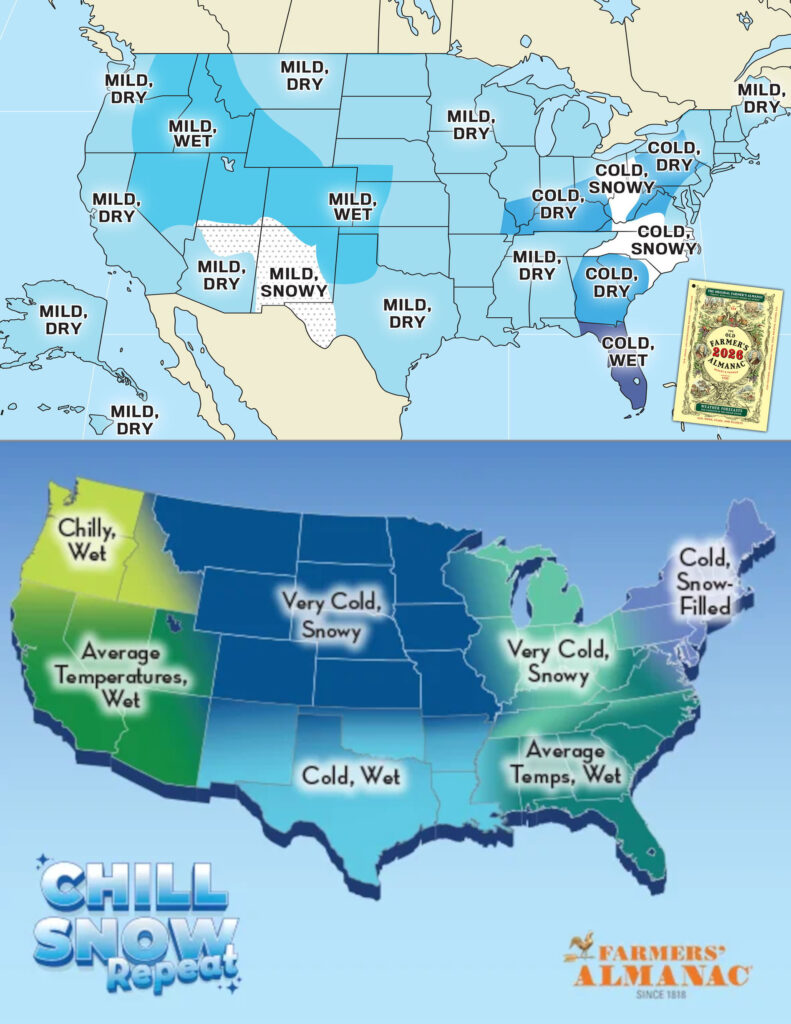
In short, the Old Farmers’ Almanac’s “Big Picture” predicted:
Temperatures: Near normal to slightly milder across most of the country—except in the Appalachians, Southeast, Florida, and Ohio Valley, where colder-than-average conditions are expected.
Precipitation: Overall below normal, with wetter areas such as Florida, the Intermountain West, and eastern Desert Southwest.
Snowfall: Near or below normal for most areas. However, greater amounts of snow are expected in much of the Carolinas, southern Appalachians, eastern Ohio Valley, southern Rockies, and eastern Desert Southwest.
“Don’t lose track of your snow shovels and umbrellas,” says Editor Carol Connare. “Most areas will experience near-normal to slightly milder temperatures, but from the Appalachians south through the Southeast and Florida, and westward across the Ohio Valley, we’re predicting a colder-than-normal winter.”
For what it calls the Atlantic Corridor, including Hartford, the Old Farmers’ Almanac predicted:
Milder and drier, with most snow falling around the holidays and late winter. Fewer snow days could ease commutes, but not as we get ready to usher in 2026.
Temperatures: Above normal.
Coldest periods: Mid- to late December, early and late January.
Precipitation: Below normal.
Snowfall: Below normal; snowiest periods in late December, early January, late February.
On the other hand, the Farmers’ Almanac predicted:
A season of dramatic swings and widespread wintry weather. Get ready to hit the slopes! When will it snow? The season’s coldest temperatures will be found from the Northern Plains to New England. Readers in the Northwest should also prepare for a cold winter, especially in Idaho and Washington.
A significant cold snap in mid-January will keep most shivering. Winter’s wrath continues with another pronounced cold spell predicted for mid-February.
Frequent snowstorms in New England should keep snow lovers happy. Areas up and down the Atlantic Coast will see significant rain, mixing with snow from time to time. The Mid-Atlantic region is forecast to see some decent snow, especially for areas in the mountains.
The Great Lakes, Ohio Valley, and North Central states are set for a classic winter wonderland, while the Pacific Northwest mountains are gearing up for some impressive snowfall totals.
Winter in the Southeast will see average temperatures with many wet periods. Northern portions, particularly in the Appalachian regions, may see occasional snow events.
Texas and the Southern Plains (western Kansas, Oklahoma, and portions of Nebraska and New Mexico) are on tap for a wetter-than-average winter with periodic cold snaps. While snow will be limited, the region may face several cold rain events and occasional freezing precipitation, particularly in northern areas.
A wet winter is also predicted in the Southwest with near-average temperatures.
Sadly, this was the Farmers’ Almanac’s last winter forecast, because after 208 years it closed shop with its 2026 edition. But the 232-year-old Old Farmer’s Almanac is still in print and online and hawking all manner of allegedly farm-related merchandise . . .
22 January—Without mentioning Donald Trump by name in his stirring address to the Davos World Economic Forum on Tuesday (which pissed Trump off anyway—or maybe because he wasn’t mentioned), Canadian Prime Minister Mark Carney declared the end of the world as we’ve come to know it. Although not quite a Cassandra, he lamented a rupture in the world order, not a transition, and said it was the duty of nations to come together through multiple appropriately flexible coalitions for the benefit of all.
Focusing on what Carney called middle powers—nations like Canada—multilateralism was the only way to go, he observed—the only way to survive in the circumstance, truth be told. But without mentioning the United States by name—except when he mentioned “American hegemony”—alluding, rather, to great powers, hegemons, and predatory nationalism—he recognized that the United States could no longer be counted on as the binding agent to hold alliances together. He could have said that again. At the same time, however, he didn’t have to say it.
Forget about the dear old rules-based order, Carney advised, because it isn’t coming back. Rather, learn to live with unconstrained great-power politics, especially with weaponized economics—specifically tariffs and supply chains—as tools of “coercion” and “subordination.”
All of Carney’s remarks were clearly—but of course tactfully—aimed at Donald Trump. But in his typically tactless response Trump reminded Mark, as Donald called Carney in his de rigueur put-down, that “Canada lives because of the United States” and “should be grateful” it “gets a lot of freebies.” What else would you expect from Trump?
Sure, Donald Trump is the worst thing that’s happened to the world since all the recent dictators combined. But he and his malignant spawn aren’t going to be around forever; hopefully they’ll be demolished—one hesitates to say exterminated, although that’s precisely how vermin are dispatched—by the 2028 election. And then, hopefully in short order, most—and eventually all—the damage, chaos, and mayhem Trump will have wreaked by the end of his term will be repaired.
Hope hope hope . . .
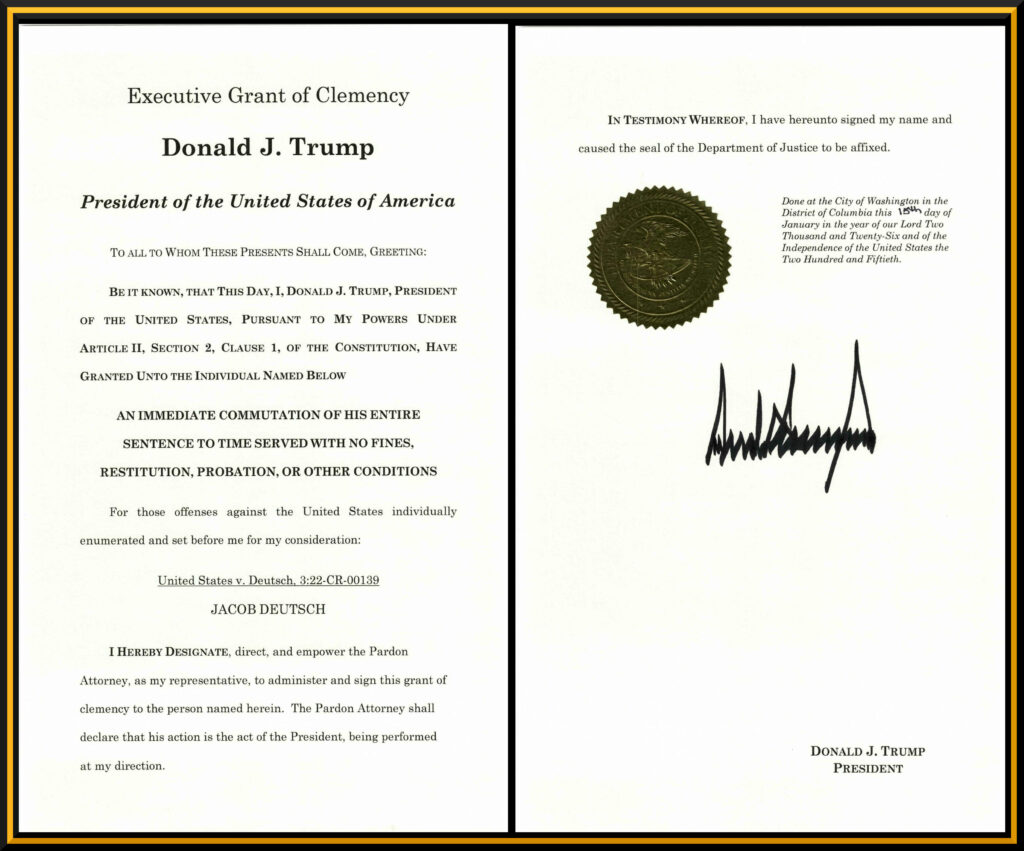
21 January—Yesterday the White House announced that last Thursday Donald Trump had commuted the “entire sentence to time served with no fines, restitution, probation, or other conditions” of Jacob Deutsch, who, along with his cousin and business-partner-in-crime Aron, had been convicted two years ago of humongous mortgage fraud. Here’s the U.S. Attorney’s extended press release when Jacob and Aron were sentenced:
“Vanessa Roberts Avery, United States Attorney for the District of Connecticut, announced that two New York men were sentenced today by U.S. District Judge Omar A. Williams in Hartford for engaging in a wide-ranging mortgage fraud scheme involving 24 mortgage loans on numerous multifamily housing properties in Hartford totaling nearly $50 million. JACOB DEUTSCH, 58, of [Borough Park] Brooklyn, was sentenced to 62 months of imprisonment and four years of supervised release, and was ordered to pay a $10,000 fine, and ARON DEUTSCH, 63, of Monsey, was sentenced to five years of probation and ordered to pay a $1 million fine.
“According to court documents and statements in court proceedings, Jacob Deutsch and Aron Deutsch work at B H Property Management, LLC (“BHPM”), a property management company that manages numerous multifamily housing properties in Hartford. From September 2016 through May 2021, Jacob Deutsch, who ran the day-to-day operations BHPM, and Aron Deutsch engaged in a scheme to defraud several financial institutions, government-sponsored enterprises Federal Home Loan Mortgage Company (“Freddie Mac”) and the Federal National Mortgage Association (“Fannie Mae”), and the U.S. Department of Housing and Urban Development (“HUD”) by providing them with false information overstating the value of multifamily housing properties managed by BHPM in connection with loans secured by those properties.
“As part of the scheme, Jacob Deutsch provided false rent rolls and falsified leases to the victim financial institutions and their appraisers, which either overstated the number of renters by listing fictitious renters or others not actually living there, or falsely inflated the amount of rent paid by occupants. Jacob Deutsch deceived inspectors into believing that unoccupied apartments were occupied by staging the apartments with furniture and by requiring BHPM employees to falsely tell inspectors they lived there and to lie to inspectors if asked whether there were vacancies. For instance, a rent roll and income and expense summary submitted by Jacob Deutsch to CBRE Capital Markets, Inc. (“CBRE”) in June 2018 falsely represented that 16 Evergreen Avenue was 100 percent occupied when, in fact, not a single tenant resided there at the time. Later, Jacob Deutsch e-mailed CBRE pictures of money orders and checks purporting to reflect rent payments from fake tenants on the falsified rent rolls for 16 Evergreen Avenue to show proof of payment of rent when, in fact, the money orders and checks had been purchased by Aron Deutsch or BHPM employees at Aron Deutsch’s direction.
“Jacob Deutsch also provided the victim financial institutions with false and inflated income statements and financials for the properties, doctored bank statements, doctored or false documents overstating the purchase price of various multifamily housing properties, and doctored checks and invoices showing false or overstated capital improvements made to those properties. The false information provided by Jacob Deutsch induced the victim financial institutions to issue loans that they otherwise would not have issued on the requested terms, or for amounts larger than they would have authorized had they been provided with truthful information. In addition, the false information induced Freddie Mac and Fannie Mae to purchase the resulting loans from the victim financial institutions, and induced HUD to issue a mortgage insurance commitment to a victim financial institution.
“Jacob and Aron Deutsch were arrested on May 19, 2021.
“After his arrest and while released on bond, Jacob Deutsch victimized another lender to secure an $11 million loan.
“Jacob and Aron Deutsch pleaded guilty to conspiracy to commit mail fraud and wire fraud affecting a financial institution on July 12, 2022, and June 1, 2022, respectively.
“Jacob Deutsch is required to report to prison on March 8.
“Jacob Deutsch’s criminal history includes a wire fraud conviction in the Eastern District of New York stemming from an insurance fraud scheme. In October 2003, he was sentenced to three months of imprisonment for that offense.
“This investigation was conducted by the U.S. Postal Inspection Service, the Federal Housing Finance Agency’s Office of Inspector General, and HUD’s Office of Inspector General for Investigations. The case was prosecuted by Assistant U.S. Attorneys Heather Cherry and Sarah Gruber.”
Although Trump offered no explanation for his clemency grant to a real estate fraudster, it’s not at all surprising. First, Rabbi Moshe Margaretten, founder of the Tzedek Association and a Trump ally, lobbied for the commutation, describing the case as a “profound miscarriage of justice” and arguing that Deutsch had been “punished with extraordinary severity.” Tzedek means justice in Hebrew. But, despite Margaretten’s insistence, justice had in fact been served—not miscarried profoundly or otherwise—in Jacob Deutsch’s conviction.
Moreover, just between us, given his affinity with real estate hanky-panky, Trump wasn’t unlikely to do a favor for a fellow grifter anyway.
No idea why there’s no mention of Aron Deutsch or his million-dollar fine in the commutation instrument which may well have been signed with an autopen . . .

20 January—On the ninth and first anniversaries of the Trump inaugurations, an observant reader writing from California reminds us that although Melania held the Lincoln and Trump bibles next to her husband for the 2021 swearing-in ceremony Trump didn’t in fact place his hand on either—or on her—for the presidential oath. He had done it in 2017. But he hadn’t had to.
For the record, John Quincy Adams in 1825 used a law book, supposedly to symbolize his oath to the Constitution; Theodore Roosevelt in 1901, after President McKinley’s assassination, didn’t use a Bible or any book; Lyndon B. Johnson, in 1963, took the presidential oath on JFK’s Catholic missal that was found on Air Force One after JFK’s death; and in 1923, Calvin Coolidge claimed that swearing oaths on a bible wasn’t the practice in Vermont (where he was born) or Massachusetts (where he was governor and died).
On the subject of Donald Trump, confidential word from the White House is that, as is the demented (not just unstable) rogue president’s wont, he has come up with two “great, brilliant, and beautiful” designs for a new presidential seal that he considers—and really are—better representations of him than an eagle and some Latin words. But he can’t decide which to use . . .

19 January—Martin Luther King Jr.s 96th birthday was 15 January but the federal holiday is today, the third Monday in January, to give most government employees an extra paid day off. It’s more than likely that Dr. King wouldn’t approve—of a holiday celebrating his birthday or a paid day off.
MLK was awarded the Nobel Peace Prize in 1964 “for his non-violent struggle for civil rights for the Afro-American population,” according to the Nobel citation. The cash was only $54,000 (about $565 thousand today), all of which he gave to non-profits fighting for civil rights.
The Nobel medal at that time (before 1980) was cast of about 6.43 Troy ounces of 23-karat (95.83 percent) gold. At today’s price, it would have an intrinsic value of about $29,000. But its value to a collector has been estimated to be at least $20 million.
Collectible value is why MLK’s kids, Martin III, Dexter, and Bernice, fought over their father’s Nobel medal and diploma, as well as his traveling bible. The boys wanted to sell the goodies allegedly to support the various functions of the nonprofit King Center, while Bernice, considering them “sacred,” thought they should be kept as holy artifacts.
In 2016, after mediation by Jimmy Carter (who had himself been awarded the Nobel Peace Prize in 2002), the boys—the estate—got possession. But the Nobel and bible are on display in the King Center in Atlanta. Go figure. Should Carter have been awarded another Nobel Peace Prize?
At his second inauguration, in 2013, Barack Obama swore his oath of office on MLK’s traveling bible, stacked on the bible Abraham Lincoln had used for his first inauguration in 1861. Obama had used that bible for his first inauguration in 2009. The Lincoln bible was furloughed by the Library of Congress for Obama’s inaugurations.
Although the Constitution doesn’t require an oath on a bible, Donald Trump desecrated the Lincoln bible, along with his own Sunday school graduation present, at both of his inaugurations. He kept it?!
18 January—So Trump Tyrannus finally has a Nobel Peace Prize. The solid gold medal, anyway, thanks to what can only be the political and diplomatic aspirations of its real winner, María Machado. And Sra. Machado’s strategic generosity didn’t go unappreciated by Trump, at least perfunctorily and superficially: “I had a great meeting yesterday by a person who I have a lot of respect for—and she has respect, obviously, for me and our country—and she gave me her Nobel Prize. . . . She’s a really—this is a fine woman.”
Sra. Machado should be making the most of questionable glory of Trump’s compliment. Because that’s likely all she’s going to get from him: some nice words, with surprisingly few about himself thrown in.
As for the real Nobel Peace Prize, Trump can forget about it. His intensive lobbying effort, well-publicized nomination by domestic and international flunkies, shameless hyperbolic and mendacious self-praise, as well as the not-inconceivable threat (given Trump’s bellicosity, instability, and threats to invade Greenland) of U.S. invasion of Norway if he doesn’t get it certainly can’t rub the Nobel Committee the right way.
Simply put, then, Trump won’t ever get the Nobel Peace Prize—unless he cleans up his act and really deserves it. Both are highly unlikely.
Shortly after Sra. Machado’s gift made the headlines, in fact, the Nobel Committee made it clear that while it has no control over what Nobel laureates do with their prizes, “the medal and the diploma are [just] the physical symbols confirming that an individual or organization has been awarded the Nobel Peace Prize. The prize itself—the honor and recognition—remains inseparably linked to the person or organization designated as the laureate by the Norwegian Nobel Committee. A medal can change owners, but the title of a Nobel Peace Prize laureate cannot.” The statement didn’t mention the cash.
Trygve Slagsvold Vedum, a Norwegian politician who supports protectionism and tariffs, put it succinctly and perceptively: “Whoever has received the prize has received the prize. The fact that Trump accepted the medal says something about him as a type of person: a classic showoff who wants to adorn himself with other people’s honors and work.”
Raymond Johansen, a former mayor of Oslo, was equally frank: “This is unbelievably embarrassing and damaging to one of the world’s most recognized and important prizes. The awarding of the prize is now so politicized and potentially dangerous that it could easily legitimize an anti-peace prize development. I can’t believe she actually gave the prize to Trump. What on earth is the Nobel committee going to say?”
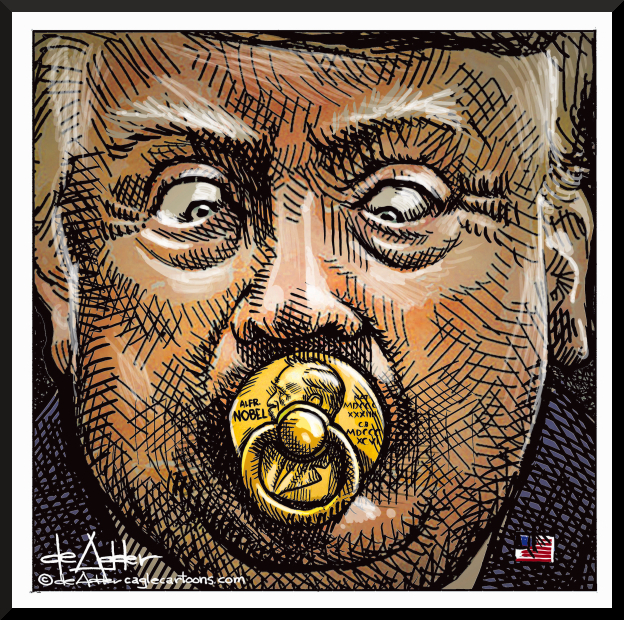
17 January—Wow and oh boy! Trump Tyrannus just got his second peace prize! You’ll recall that last month FIFA, the good folks who corrupt soccer all over the world, awarded him their inaugural annual Peace Prize in recognition of his “exceptional and extraordinary actions for peace,” specifically citing his efforts to unite people across the world. [FIFA must know something nobody else knows. And when will the equally corrupt IOC—International Olympic Committee—start awarding peace prizes? Ed.]
You’ll also recall that when María Machado was deservedly awarded the Nobel Peace Prize last October, she insisted it should have gone to Trump. We won’t speculate on her motivation. But she should have known better.
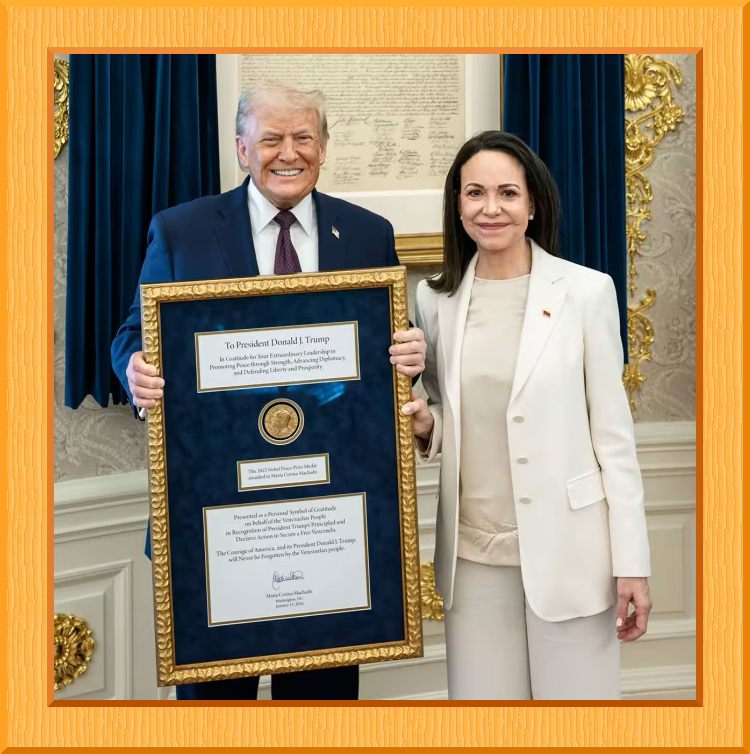
Nevertheless, just a couple of days ago, Sra. Machado actually followed through and awarded her Nobel Peace Prize to Trump Tyrannus. Well, she gave him the gold Nobel medal in a gold-colored frame, anyway, embellished with this obvious sucking up on two discrete pages:
“To President Donald J. Trump. In gratitude for your extraordinary leadership in promoting peace through strength, advancing diplomacy, and defending liberty and prosperity.” [Bully that! Bully’s the word. Ed.]
“Presented as a Personal Symbol of Gratitude on behalf of the Venezuelan People in Recognition of President Trump’s Principled and Decisive Actions to Secure a Free Venezuela. [Certainly decisive. But principled? Ed.]
“The Courage of America and its President Donald J. Trump will Never be Forgotten by the Venezuelan People.” [Probably right. And why all the capitals? Ed.]
All that sucking up and Trump Tyrannus still disses Sra. Machado. Unlike Trump, she has earned and certainly deserves the respect of the world. But to Trump she’s only a woman he can’t grope—diplomatically or otherwise.
In spite of that, have you ever seen Trump Tyrannus looking genuinely happier than in the photo below? He’s coveted the Nobel Peace Prize since who knows when, to be sure. But there’s also the gold in the medal to indulge his notorious passion for gilded glitz. The medal weighs about 5.6 Troy ounces of 18-karat—75 percent—electrum (green gold) and is plated with 24-karat gold. So at the current spot price there’s about $20,000 worth of gold in Trump’s secondhand Nobel medal. Silver comprises the other 25 percent of the electrum, with perhaps a soupçon of copper, so it adds only about $125 to the intrinsic value.
The cash award that went along with last year’s Nobel Peace Prize medal and diploma was about $1.2 million. Bupkes—to Trump Tyrannus, anyway. The scratch varies depending on the Nobel Foundation’s investment returns. And if Sra. Machado were a U.S. resident it would be taxed as ordinary income. The United States is one of the few countries that tax such windfalls.
To be continued . . .
16 January—Upon digesting Wednesday’s disquisition on canned USPS post-Christmas gratitude, a reader in Blighty commented: “How refreshing! Our Post Office—mail—has been taken over by a Czech, and the Postal rates have gone sky high. £1.70 first class letter. £0.87 second class letter. (3 days delivery). Europe. £3.40. World incl. USA £3.40
“Usurious!”
Incredible and unbelievable, outrageous and extreme. If the sterling figures sound astronomical, at today’s exchange rate, £1.70 translates to a whopping $2.28. That compares to the 78 cents the USPS currently charges for a first-class Forever stamp. And £3.40 translates to a more whopping $4.56, compared to USPS’s mere $1.70 international First-Class Forever stamp. And it’s pretty much in line with postal rates for letters all over the world. Certainly makes the United States Postal Service seem at least a little less unreasonable.
As for usurious, the UK Post Office does in fact lend money online through a third-party shylock at interest rates some may consider usurious, but that’s a different story. In fact, the whole British postal system is a different story. First, there’s Post Office Limited, the state-owned network of about 11,500 access points. Those are the retail locations that are essentially like USPS post offices but provide more services, many, like banking, being legacies of the old GPO—General Post Office—state monopoly. The GPO also ran the telephones. And in the old days you stuck a postage stamp on just about everything, kind of like a wax seal.
Then there’s the Royal Mail that actually carries the mail for the government. It was privatized in 2013 and most recently was acquired by the Czech EP Group just last year. His Majesty’s (poor excuse for a) Government retains a so-called “golden share” of the Royal Mail; its nominal value is only one pound, but it gives HM(pefa)G’s bureaucrats full veto power, presumably to keep it from screwing the public even more than it’s already done. (Golden shares bring to mind Trump Tyrannus and Nippon Steel, but that’s not for now.)
Simply put, then, there’s Post Office Limited, where you drop off and can pick up mail, and Royal Mail that carries and delivers mail to homes. If you were wondering or even knew about it, official-sounding UK Mail isn’t part of the British postal system. It’s owned by the American-founded, now German, DHL Group and competes with Royal Mail, just as UPS, FedEx, and DHL compete with the USPS.
Not too long ago—between 1999 and 2015—the Blighty Post Office, then fully owned by the state, was positively—make that negatively—quaked by the Horizon IT scandal, named after the faulty Fujitsu accounting software, essentially a typical corner-office bureaucratic cover-up of a computer software glitch that metastasized disastrously, causing hundreds of false civil and criminal prosecutions of local postmasters; personal, family, and corporate hardship (to put it mildly); and at least 13 suicides.
No postmaster was guilty, only senior Post Office executives. Many of the innocent victims have been compensated to some extent by HM(pefa)G, but the restitution is progressing very slowly. Typical.
No surprise that none of the bureaucrats responsible for the tragic travesty have been criminally charged, although an investigation is said to be ongoing—after all this bloody time. And, of course, no executives of the Post Office or Fujitsu have been fired specifically due to their involvement with the Horizon scandal.
So what else is new?
15 January—Just this morning, after one of his masked ICE goons shot and injured—but failed to kill (doubtless to his chagrin)—a man in Minneapolis last night, the tyrant Donald Trump—hereafter referred to as Trump Tyrannus—threatened to invoke the Insurrection Act: “If the corrupt politicians of Minnesota don’t obey the law and stop the professional agitators and insurrectionists from attacking the Patriots of I.C.E., who are only trying to do their job, I will institute the INSURRECTION ACT, which many Presidents have done before me, and quickly put an end to the travesty that is taking place in that once great State,” the wannabe emperor of the world declaimed on his website.
Getting past the irony of Trump Tyrannus’s declamation, given his own monumental corruption and insurrection, which likely never will be punished, the wannabe emperor of the world was right about many presidents having invoked the Insurrection Act, which allows a president to send military troops to areas in order to quell civil unrest. Here are some such invocations:
President George Washington, invoking the predecessor of the Insurrection Act, the Militia Act of 1792, personally led state militia forces into western Pennsylvania to suppress a large revolt sparked by a new federal tax on liquor production in 1794. Washington, who was 62 at the time, remains the only sitting president to have led an army in the field. Can you imagine an obese draft dodger doing anything like that?
Almost five years later, President John Adams sent troops to put down Fries’s Rebellion, this time in eastern Pennsylvania, but again about a federal tax, this time on real property.
In 1861, President Abraham Lincoln invoked the Insurrection Act in response to the secession of seven southern slave states at the outbreak of the Civil War.
After the Civil War, in the 1870s, President Ulysses S. Grant invoked the Insurrection Act six times—most of any president—to combat white supremacist violence (including by the Ku Klux Klan) in the South.
In 1932, President Herbert Hoover did not invoke the Insurrection Act when he deployed troops to deal with the so-called Bonus Army—thousands of Great War veterans and their families who had been affected by the Great Depression and had set up camp in D.C. to try to get early payment of the bonuses they’d been promised.
But the willful screw-up Army Chief of Staff, General Douglas MacArthur (with Majors Dwight D. Eisenhower and George S. Patton hanging on), as was his wont, without legal authority and blatantly ignoring Hoover’s instructions, proceeded as if the Insurrection Act had been invoked and thus sent in cavalry, tanks, and tear gas to disperse the unarmed veterans, and torched their camps.
MacArthur’s disgraceful but entirely unsurprising insubordination—for which he suffered no consequences (of course)—killed two men at the site and resulted in the later death of an 11-week-old baby. (But were any of the troops aware that MacArthur was acting illegally?)
In 1957, three years after the Supreme Court had struck down the “separate but equal” basis of racial segregation, President Dwight D. Eisenhower invoked the Insurrection Act to protect black pupils at a Little Rock, Arkansas, high school.
In 1962, President John F. Kennedy invoked the Insurrection Act to get a black student enrolled at the University of Mississippi; and in 1963, to get black pupils enrolled at white public schools in Alabama.
In 1965, 1967, and 1968, President Lyndon B. Johnson invoked the insurrection Act in defense of black civil rights.
The last invocation of the Insurrection Act was by President George H.W. Bush in 1992, at the request of California Governor Pete Wilson, after the Los Angeles cops who had beat the crap out of Rodney King were acquitted by a no-black jury, fomenting large-scale civil unrest. Like race riots.
Bottom line, it certainly looks like sociopathic Trump Tyrannus is itching to incite another Bonus Army massacre and will use any lame excuse to invoke the Insurrection Act . . .
14 January—It appears that etiquette has infiltrated the United States Postal Service. Last week this heartfelt letter from Bantam’s new postmistress was posted by Litchfield.bz:
To the Editor:
Jan. 9
As we turn the page on the holidays, I want to thank our customers in Bantam for the patience, kindness, and support you showed our local Postal Service team during the busiest mailing and shipping season of the year.
Our carriers, clerks, and plant teams worked hard to keep mail and packages moving for families, small businesses and neighbors who rely on us. Behind every delivery is a local employee who lives here, shops here and cares about getting it right.
Now that the holiday rush is behind us, our focus is simple: steady, dependable service every day — along with continued improvements that help us handle today’s mix of letters and packages more efficiently.
If you had a great experience with your local post office this season, I hope you’ll share it with our team. And if we missed the mark, please let us know so we can keep improving at usps.com.
Katie LaPointe
Postmaster, Bantam post office
And the Hearst RepublicanAmerican opinion editor found room for this heartfelt letter from Waterbury’s almost-as-new postmaster in today’s number:
Waterbury postmaster thanks community for support during holidays
As we turn the page on the holidays, I want to thank our customers in Waterbury for the kindness and support you showed our local Postal Service team during the busiest mailing and shipping season of the year.
Our carriers, clerks, and plant teams worked hard to keep mail and packages moving for families, small businesses, and neighbors who rely on us. Behind every delivery is a local employee who lives here, shops here, and cares about getting it right.
Now that the holiday rush is behind us, our focus is simple: steady, dependable service every day — along with continued improvements that help us handle today’s mix of letters and packages more efficiently.
If you had a great experience with your local Post Office this season, I hope you’ll share it with our team. And if we missed the mark, please let us know so we can keep improving at usps.com.
Tyler York
Postmaster, Waterbury Post Office
135 Grand St.
Waterbury, CT 06701
It’s really gratifying that at least two local USPS officials have taken the time and trouble to show their appreciation. May one assume that all the nation’s postmasters, acting postmasters, and officers-in-charge have in fact done the same, and if postal customers haven’t received hard-copy stamp-and-butter letters, they were probably lost in the mail?