20 September—As some aged readers may know, Chase sold its AARP credit card business to Barclays, an English bank that opened shop in the USA several decades ago. The big switch took place at 6 a.m. this morning. I activated my new credit card over the phone while having breakfast. No problem at all. Portent of things to come?
That’s the good part.
When I arrived in England in 1965, an innocent abroad, I was advised against opening current and deposit (what we call checking and savings) accounts with Barclays because of inferior service. I never questioned it. And it was 56 years ago. And I don’t recall no-fee bank credit cards back then.
So I went to Lloyds, whose local branch was more convenient anyway. I never regretted that. And I enjoyed watching the tellers quaintly post deposits and withdrawals in my passbooks by hand. Just like in Dickens’ day. We’ll never see that again.
Back to 2021, after I set up my new account on BarclaysUS.com website—a pain in the ass, but what the hell—some questions occurred to me. So I phoned the number on my new credit card. As I type this, my speaker phone has been on hold, waiting for a—get this—“relationship manager” for 53 minutes to get to me. Of course, my call is very important to Barclays.
While waiting in the queue—a popular British pastime, as I recall—to get to one relationship manager, I phoned the customer service number mentioned on the website. And my mobile phone has been waiting for a relationship manager for 35 minutes. At least the recording on this hold is apologetic for keeping me waiting while the relationship managers deal with other customers. And it says please. But it doesn’t assure me that my call is important. As if the recordings and Barclays mean any of it.
Well, I’ve just terminated the calls. I’ll keep calm and carry on by complaining on the BarclaysUS.com website. I’ll see what happens. I’m not expecting much—or anything—so I won’t be disappointed. I will say that in my quarter-century with Chase, I never had a problem or complaint about anything, including being kept on hold . . .
19 September—I was typing these observations about sidewalk dining a week ago, when my faithful old desktop computer appeared to drop dead. So I kept calm, carried on, and attached all the desktop peripherals to my eager young laptop computer, while computer-repair wiz Jonathan “JC” Tieman got the doughty desktopper working again. And bringing it back to life didn’t cost much at all.
Dining on the sidewalk appears to have become rather fashionable with the advent of the novel coronavirus and consequent conditions and restrictions imposed by arbitrary fiat on restaurants and other businesses by state and local governments. But I’ll never understand why people would be willing—let alone eager—to dine in a public walkway.
Sidewalk restaurants had in fact been in vogue in many locales even before the COVID-19 panic made them de rigueur virtually everywhere. Without doubt, on a beautiful day, dining alfresco can be quite pleasant.
Outdoor dining, when it’s not at an ad hoc sidewalk restaurant, can be absolutely delightful. I’ve done it myself. And I’ve actually enjoyed it. But never on a sidewalk. Even in France, for instance, the so-called sidewalk cafes aren’t ad hoc, aren’t really sidewalk cafes at all, are really fenced off from the actual trottoirs, and don’t interfere with pedestrians. And pedestrians don’t interfere with diners or servers.
But when I walk down Litchfield’s West Street on a nice day and look at the people sitting at the tables that are blocking the sidewalk and the people stare back at me, I wonder if they feel that I’m invading their personal space. Not that I care, of course. They must have known when they opted for the sidewalk that people like me would try to spoil their meals.
Funny thing, though, is that most sidewalk diners seem oblivious to sidewalk pedestrian traffic. They’re either engaged in conversation with fellow diners or engrossed in whatever their cell phones are showing them. Some diners are actually eating, which often is no fun to watch. But on a really good day, they’re trying to keep their food and napery from blowing away. That’s especially entertaining.
An undeniable advantage to sidewalk dining—in Connecticut, at any rate—is that your dog can dine right along with you. And you can get a doggy bag to take home anyway. But you can also take your dog to a proper outdoor restaurant that’s not blocking the sidewalk. And does anyone actually give the doggy bag leftovers to their poor, starving dogs?
I deeply regret that my late Scotties, Cash and Maisie, aren’t around to interact with pooches waiting patiently while their owners pig out on West Street pavement.
What about dining in a commandeered commercial or municipal driveway? Better than a sidewalk on privacy grounds and convenient for the restaurant that controls the driveway, to be sure, but definitely inconvenient for vehicular traffic that would otherwise be using the driveway.
Then there’s alfresco dining in cramped courtyards not originally intended for the purpose, as was tried in Litchfield’s claustrophobic Cobble Court even before the COVID-19 panic. It didn’t work out all that well, as I recall; but then the virus came along.
It must be noted, by the way, that when Italians talk about alfresco or al fresco, they’re usually not talking about dining, but rather about prisons . . .
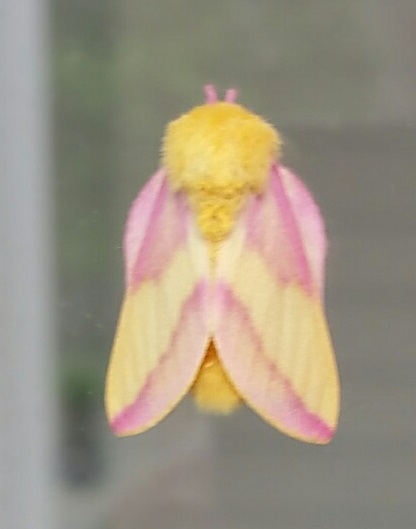
18 September—This is a picture I took recently of a rosy maple moth (Dryocampa rubicunda) that was relaxing on a door of the Litchfield post office. Although I can’t recall ever having seen one of these cute, fuzzy little creatures before, they’re not all that uncommon around here.
They’re the smallest of the Saturniidae, the great silk moths, having a wingspan of about 1½ inches. The adult females lay their eggs on the underside of maple leaves—particularly red, silver, and sugar maples, though they’ll also resort to various oaks in a pinch—and the emerging caterpillars—greenstriped mapleworms—feast on the leaves, eating whole blades. Happily, the defoliation doesn’t do permanent damage. Wouldn’t it be a bitch if these cute moths were as destructive as their less attractive cousins?
After gorging themselves, the larvae crawl down and pupate in the soil beneath the same tree whose leaves they’ve devoured. Why travel when everything you need is right at hand?
To atone for their gluttonous infancy, adult rosy maple moths, like all the Saturniidae, don’t eat. By thus staying in shape, the cute little bugs can live from two to nine months. And although the adults aren’t dangerous, the greenstriped mapleworm caterpillar is one of the so-called stinging caterpillars, having urticating—stinging—spines that contain a toxin and can irritate human skin if they come in contact. But the caterpillars aren’t cute anyway, so you wouldn’t want to pet them . . .

17 September—A professor at Harvard and MIT—where else?—wants to “genetically resurrect” a woolly mammoth. Starting out with some $15 million raised by a “de-extinction” startup called Colossal, Professor George Church, a principal of Colossal Inc, says that’s probably enough to get an embryo. Of course, the professor asserts that millions more will be necessary to bring the embryo to term and get a calf. He doesn’t talk about raising the calf to adulthood. And clones?
Shades of Jurassic Park, you say. Where’s Richard Attenborough? Or his younger brother, David? But the amusement park and profit motive don’t at the moment seem to be a part of Colossal’s mammoth plan. (Colossal and mammoth in one phrase, wow! Talk about emphasis.) George Church is an acknowledged pioneer in genome sequencing and gene splicing. So he’s the man. He wants to see woolly mammoths “walk the Arctic tundra again,” with the hope the resurrected species can play a role in combating global warming.
And presumably the woolly mammoth resurrection is only the start of the de-extinction revolution.
Colossal Inc, whose colossally overpowering Colossal.com website is a seminar in itself, purports to promote species preservation as well as resurrection “on behalf of humanity, the animal kingdom and the universe at large.” Makes sense. It’s all part of de-extinction, when you get down to it.
But do we really want to bring back extinct species? Species became and become extinct through forces and processes for whatever reasons, after all, whether they be natural or anthropogenic. (And even events caused by Man are really natural, when you think about it.) It’s part of the evolutionary process on Earth, natural selection, survival of the fittest.
If Church and Colossal’s Mammuthus primigenius redivivus—the resurrected woolly mammoths—were actually to be set up in the Arctic—as well as in zoos and amusement parks all over the world, of course—what purpose would it serve? Forget about changing climate change. Only the planet can do that. And would the poor anomalies even survive without a little help from their human friends?
Instead of encouraging fiddling with nature in the interest of academic and scientific one-upmanship, Colossal’s millions would be better spent protecting and preserving living animal species and fighting animal cruelty . . .
16 September—Checking out of Aldi’s the other day (where produce and a number of other prices have really spiked), I put a credit card receipt in the breast pocket of the shirt I was wearing. But the pocket wasn’t there. Instead, there was a useless embroidered horse and rider. Make that a useless embroidered polo pony and rider. For I was wearing a genuine Ralph Lauren Polo button-down dress shirt.
What the hell was I—certainly a paramour of elegance, but by no means a dedicated follower of fashion—doing, wearing a fashionable, expensive Ralph Lauren shirt? Maybe it’s not fashionable, certainly not expensive, because I had bought that shirt, and many others, at the late Richard Derwin’s clearance outlet some 30 years ago. Who cared about missing pockets or silly embroidered trademarks at those prices?
But I digress. As I was driving back to Litchfield, the polo pony got me thinking about identity and belonging. Why do people wear clothing—like baseball caps and sweatshirts—that identifies them with particular groups? Why do people want to be identified with particular groups? Why do people want to belong to groups? Why indeed do people belong to groups?
Easy. And briefly. Animals do it, so why shouldn’t people? Human beings—Homines sapientes, being the plural of the present surviving human species, Homo sapiens—are pack or herd animals. There are clear advantages to groups, like safety, strength, and synergy in numbers; a degree of anonymity; a degree of companionship. That’s why archaic human species lived in tribes, just like the so-called lower animals.
Groups are normally more effective in getting things done. That’s why there are political parties and lobbying organizations, which carry more clout than individuals. That’s why there are clubs of all sorts that support members’ interests.
Most people aren’t reclusive, so groups provide companionship as well as well as support. Identifying with particular groups usually has social significance; hence, baseball caps, sweatshirts, and prominent clothes labeling. Not to mention snob appeal.
And then there are religions. Super groups, if you will, because they really serve all those purposes, but for the wrong reasons. Religions were created simply to control people through fear, hope, and ritual. What little good religions may accomplish is purely incidental to that primary mission of control in order to benefit themselves . . .
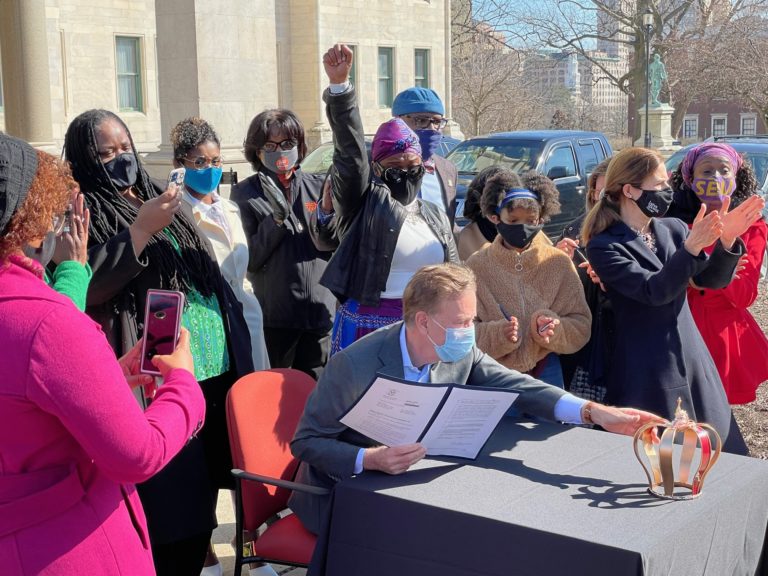
15 September—King Ned Lamont is going to ask—make that tell, instruct, command—his loyal partisan vassals in the General Assembly to extend his benevolently despotic powers for another three months. Or so. So Ned will be calling all the shots all by himself—with token approval of his claque, to be sure—as he’s been doing for 18 months. Hey, what’s another three months anyway?
So here’s a picture of King Ned accepting his crown at the coronation. After all, what good is a king without a crown?
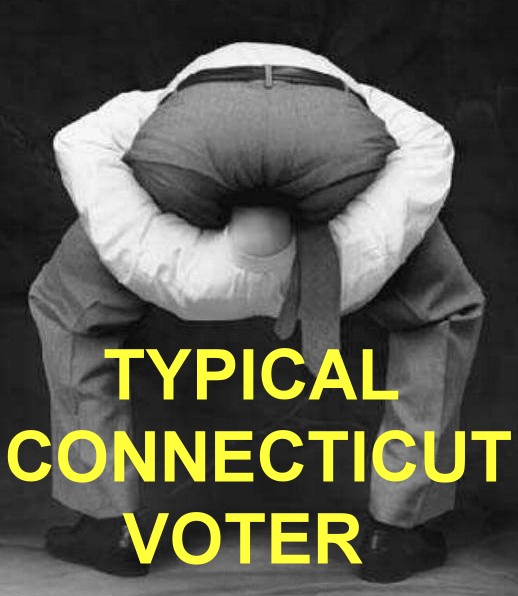
14 September—On primary day, this picture is worth well over a thousand words:
13 September—Desktop computer still down, digital wizard coming over this afternoon to diagnose, repair, maybe even upgrade the old thing to be ready for Windows 11, which I don’t look forward to; I haven’t even learned to peacefully co-exist with Windows 8.1. Meanwhile, the little laptop is filling in admirably. Since, however, the little laptop keys don’t get along too well with my fat, clumsy fingers, I’ll be brief with today’s comment.
We read that this past year Connecticut state employees have been paid for lots and lots of overtime. Surprised? I have no idea whether the overtime hours were actually worked, but let’s assume most of them were. After all, there were actually employees struck down with the novel coronavirus as well as other maladies, among legitimate reasons for the remaining employees to put in overtime.
But nowhere have I seen reference to what’s likely a significant—if not the primary—driver of the excessive overtime burden on taxpayers: the deal Gov. Dannel Malloy and his [sic] Democrat General Assembly made a few years ago with state employee unions that moderately reduced benefits for those who retired after June 2022.
Something over a quarter of state employees will be eligible for retirement by then.
When you consider that state police and correctional officers, among others, get pensions based on their highest three years’ wages (normally their last three), and that all the overtime put in during that lucrative triennium is contractually included in the pension calculation, it certainly makes sense for eligible employees to retire before the end of June 2022 and to put in—and to have put in—as much overtime as possible before the wonderful retirement date.
As an example of the indecent giveaway, even before the sell-out to the unions, a good number of non-command state police officers were being paid over $200,000 a year—lots, if not most, of it in overtime—prior to retirement, resulting in handsome six-figure pensions.
It certainly stinks. But I really can’t blame them. I’d do it myself . . .
12 September—Today’s post will be a bit late. Like by a day or three.
Just as I was finishing this morning’s essay—animadversions on sidewalk dining—my pretty reliable eight-year-old desktop computer dropped dead. Went black, no power to anything. Not the CMOS battery. Probably the transformer. We’ll see.
Meantime, it’s Sunday anyway. So I’ll take it easy, keeping calm and carrying on. Although typing on my laptop computer isn’t easy, I’ll try to come up with something for tomorrow that won’t embarrass me . . .
11 September—“Just for the record, we shouldn’t have been in Afghanistan in the first place. That goes back at least four decades, when we sent materiel to the mujahadeen to fight the Soviets and protect the opium trade. And, as an ugly aside, the Taliban are recovering and using the magnificent military materiel we’re abandoning as our troops flee ignominiously. They and the Afghans who have depended on us deserve much better.”
That’s the last paragraph of my 22 August post. When I wrote it, I had no idea of the incredible magnitude of the materiel the United States was abandoning. Having spent—make that wasted—almost 900 billion dollars in Afghanistan since 2001, the geniuses in the Pentagon are leaving behind several billion worth of everything from bottled water, energy drinks, and MREs (meals ready-to-eat) to civilian vehicles to MRAPs (mine-resistant ambush-protected vehicles).
Not to mention countless helicopters and fixed-wing aircraft, Humvees, firearms and other ordnance, and . . . the catalogue of abandoned materiel is just too sickening to consider.
The Pentagon insists that many of the land and air vehicles and lots of the ordnance has been rendered unusable and that the Taliban don’t have the smarts to repair, operate, or deploy most of their booty anyway. Yeah, right. That’s the same Pentagon that promised an “orderly and safe” departure from Afghanistan. And the Taliban’s evil allies are bound to come to its aid at the drop of a hat.
Even given the antecedent condition of gratuitous American presence in corruption-riddled Afghanistan, did our exit have to be so poorly planned and executed, embarrassing, and dishonorable? And, not even considering that we effectively surrendered valuable materiel to our enemy, couldn’t the Pentagon—and the feckless Trump and Biden administrations—have planned ahead for the “orderly and safe” redeployment of materiel and rescue of human beings?
10 September—Here’s the promised update on the Price Chopper/Market 32 Jewish new year email. After waiting over a week to get at least an acknowledgement from the Golub Corporation to my question about what criteria were used to determine the lucky recipients of the Rosh Hashanah greeting and related product ad, I phoned the buggers.
Golub’s toll-free customer-service number that actually takes you to corporate headquarters in Schenectady rather than a contractor in Bangalore or Manila (unlike most others) is a sick joke (like most others). Interminable hold times, inoperative switching choices, dropped lines—the whole schmear that seems intended to discourage customers from pursuing complaints.
Speaker phones were invented for calling customer-service numbers.
First time I called Golub, having pressed the call-back option that didn’t work, I waited on hold for 26 minutes before the call was terminated, but not by me. So I pressed redial and tried a different number sequence. No better luck second time around.
So I phoned the corporate number. It’s not toll-free, but with Internet phones it doesn’t matter. First time around at corporate, after a considerably shorter menu of choices, I was greeted by a sweet girl who sounded like she was still in grade school. I was having a very pleasant chat with her when the call just faded away.
I kept calm and carried on by hitting redial. This time, a somewhat more grown-up sounding woman greeted me and I gave her my number just in case, even though her switchboard probably had caller ID. This operator was supposed to connect me with the PR manager, but she must have pressed the wrong button because I was put on a queue for lost loyalty cards.
Third time around, the school girl was back and apologized for the faded call and her friend’s screw-up. I asked for any executive’s name and extension just in case. But she actually put me through to a person presumed to be the PR manager.
And the putative PR manager apologized profusely: first, for my unpleasant phone experience—“Very high call volume,” she bromided. “Lots of complaints?” I wondered. “Oh no, lots of questions and lost cards lately. We do get our share of complaints, but mostly compliments and questions.”
Next, why nobody had responded to my email question? Another apologetic bromide from the PR pro, harking back to the first one, invoking the unusually-high-volume-of-email defense, but assuring me I’d be getting a reply. I told her not to worry, because I wasn’t counting on it.
And finally, who got those Rosh Hashanah emails? Everybody. That’s right, everybody who’s signed up for Price Chopper/Market 32 emails got them. No algorithms for Jewish-sounding names or anything like that. In other words, you didn’t have to be Jewish to get Rosh Hashanah greetings. Even from a corporation closely held by a Jewish family.
Boy, what a relief!
And while I had her ear, I asked the nice PR pro why Price Chopper calls its customers guests. (Like Target, right around the corner in Torrington.) “Well,” she asked, “don’t you think it’s friendlier, more intimate to have guests?”
“Absolutely. But when I have guests, I don’t make them pay.” The PR pro couldn’t control her laughter. It hadn’t occurred to her . . .